


Lesson 10 – Reflexive Property
Introduction
Welcome to our lesson on the Reflexive Property! In mathematics, the Reflexive Property is one of the fundamental properties of equality. It may seem like a simple concept, but it has profound implications for solving equations and proving theorems.
This lesson will explore the Reflexive Property, how it can be used, and its importance in mathematical reasoning. Whether you are a student just starting in math or an experienced mathematician, this lesson will provide you with a solid understanding of the Reflexive Property and its relevance in mathematical equations and proofs.
Let’s get started!
I. Definition and explanation
1. Reflexive property definition
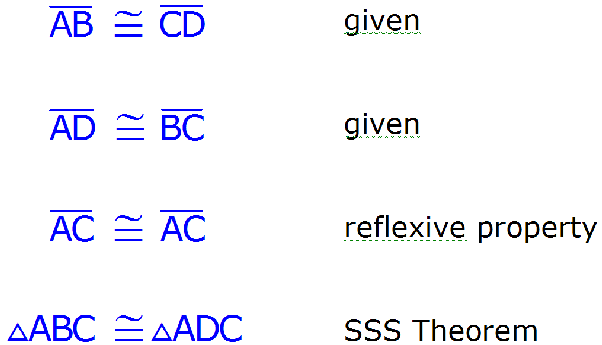
The reflexive property is a fundamental principle in mathematics that states that any object or number equals itself. In other words, it asserts that an entity is always identical to itself, with no change or discrepancy. This property reflects the inherent self-identity of an object or number.
2. Explanation
It is important to note that the reflexive property can be applied to various mathematical objects across different branches of mathematics. Let’s explore how this property is relevant to different mathematical entities:
- Numbers: When considering numbers, the reflexive property holds for any real number, rational number, irrational number, or even complex number. For instance, whether we have the number 5, π (pi), or √2 (the square root of 2), they are all equal to themselves: 5 = 5, π = π, √2 = √2.
- Variables: In algebra, variables represent unknown quantities or general values. The reflexive property allows us to establish that a variable equals itself. For example, if 'x' is a variable, we can state that x = x. This may seem obvious, but it is a fundamental property that enables mathematical operations and reasoning.
- Sets: Sets are collections of distinct elements. The reflexive property applies to sets when an element is a member of the set. If a set A contains an element 'x', the reflexive property ensures that x is an element of set A. This can be represented as x ∈ A, indicating that 'x' belongs to set A.
- Geometric Figures: Even in geometry, the reflexive property plays a role. For instance, when considering a line segment AB, the reflexive property tells us that AB is equal to itself: AB = AB. This property affirms that the line segment remains unchanged and is identical.
By understanding and applying the reflexive property to different mathematical objects, we can establish the fundamental concept of self-identity within mathematics. This foundational principle forms the basis for various mathematical operations, reasoning, and proofs.
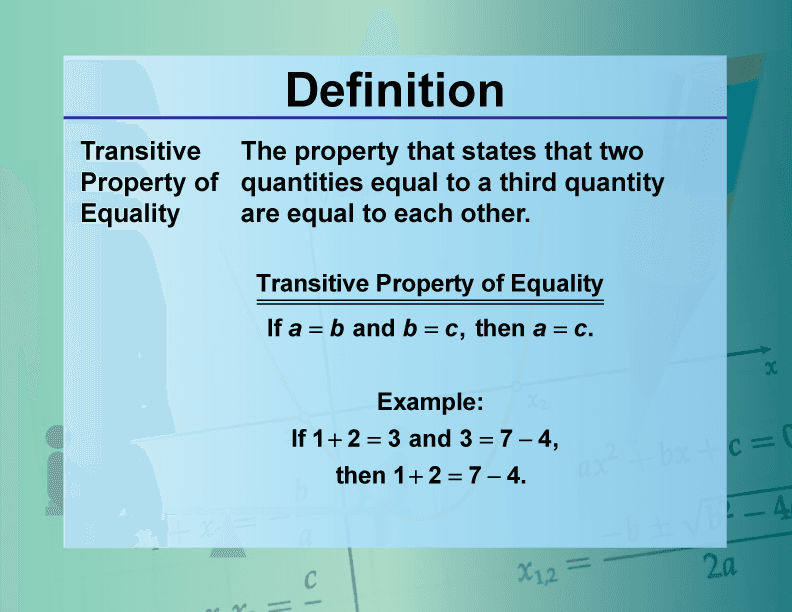
The reflexive property is a property that states that any object is equal to itself.
In other words, for any object a, a = a. This property is often used in mathematical proofs and is essential for understanding the relationships between different mathematical objects.
Hence, a relation is reflexive if:
(a, a) ∈ R ∀ a ∈ A
Where “a” is in the set “A”, the ordered pair (a, a) belongs to the set of real numbers “R”.
In other words, if you substitute any value of “a” from the set “A” into the ordered pair (a, a), the resulting pair will be an element of the real numbers set “R”.
For example, if A = {1, 2, 3}, then (1, ), (2, 2), and (3, 3) all belong to the set of real numbers “R” since each of these ordered pairs has the same value for both the first and second element (i.e., they have the form (a, a)).
3. Reflexive property formula
Number of reflexive relations on a set with an ‘n’ number of elements is given by:
N = 2n(n-1)
Supposedly, a relation has ordered pairs (a, b). Here the element ‘a’ can be chosen in ‘n’ ways, and the same for element ‘b’. So, the set of ordered pairs comprises n2 pairs.
According to the definition of a reflexive relation, (a, a) must be included in these ordered pairings. There will also be n pairs of (a, a). Hence, the number of ordered pairs here will be n2-n pairs. Therefore, the total number of reflexive relations here is 2n(n-1).
4. Example and non-example of Reflexive property
For example: If we have the expression x + 5 = x + 5, we can use the reflexive property to simplify it as x + 5 = x + 5.
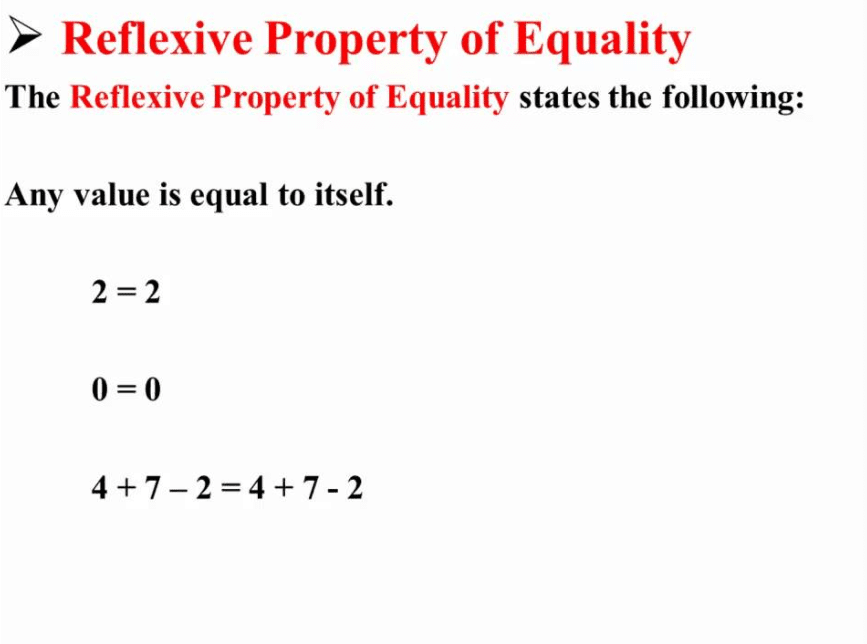
In geometry, the reflexive property shows that any object is congruent to itself. For example, if we have a triangle ABC, the reflexive property tells us that AB is congruent to AB, BC is congruent to BC, and AC is congruent to AC.
In calculus, the reflexive property shows that a function equals itself. For example, if we have a function f(x) = 2x + 3, the reflexive property tells us that f(x) = f(x).
For non-examples:
The statement 3 < 3 is not reflexive because 3 is not less than itself.
The property that states that any object is not equal to itself is not an example of reflexive.
II. Application
The reflexive property finds practical application in equations, enabling us to establish equality. Let’s explore a couple of examples to see how the reflexive property can be applied in equations:
Example 1: Consider the equation 2x + 3 = 2x + 3.
Solution: By applying the reflexive property, we can state that both sides of the equation are equal. This is because each side represents the same expression, and the reflexive property assures us that an object is equal to itself.
Therefore, we can confidently say that 2x + 3 is equal to 2x + 3.
Example 2: Let’s examine the equation x^2 = x^2.
Solution: Here, the reflexive property allows us to show that the expression on the left side is indeed equal to the expression on the right side.
By applying the reflexive property, we assert that [Phương trình] = [Phương trình], as both sides represent the same mathematical entity-namely, the square of ‘x.’
In both examples, the reflexive property helps us establish equality by recognizing that the expressions on both sides of the equation are identical. This property provides a foundational understanding of equality in mathematical equations, enabling us to confidently reason and manipulate equations with the assurance that the objects involved are equal to themselves.
By utilizing the reflexive property, we can simplify equations, perform algebraic operations, and draw valid conclusions when dealing with various mathematical equations and expressions. It is a fundamental equation-solving tool, allowing us to identify and establish equality between different mathematical quantities.
III. Guided Practice
For 15 minutes, students have to work in pair/groups to ensure the knowledge and improve skills to solve these questions:
Q.1: A relation R is on set A (set of all integers) is defined by “x R y if and only if 2x + 3y is divisible by 5”, for all x, y ∈ A. Check if R is a reflexive relation on A.
Solution: Let us consider x ∈ A.
Now 2x + 3x = 5x, which is divisible by 5.
Therefore, xRx holds for all ‘x’ in A
Hence, R is reflexive.
Q.2: A relation R is defined on the set of all real numbers N by ‘a R b’ if and only if |a-b| ≤ b, for a, b ∈ N. Show that the R is not reflexive relation.
Solution: The relation is not reflexive if a = -2 ∈ R
But |a – a| = 0, which is not less than -2(= a).
Therefore, the relation R is not reflexive.
Conclusion
In conclusion, the reflexive property is a fundamental concept in mathematics that states that any quantity is always equal to itself. This lesson taught students how to apply the reflexive property to algebraic equations and other mathematical concepts.
By mastering this property, students can become more proficient in algebra and other mathematical subjects and develop problem-solving skills useful in everyday life.
The reflexive property is a simple yet powerful tool that plays a crucial role in mathematics, providing a solid foundation for more advanced concepts.