


Lesson 1 – Scientific Concepts and Vocabulary
Introduction
Science is a field rich with concepts and specialized vocabulary. Understanding scientific terminology is fundamental to mastering the subject, as it allows students to grasp complex ideas, engage in scientific discourse, and follow advancements in the field. Scientific vocabulary can often seem daunting due to its specificity and the use of Latin and Greek roots. This lesson aims to demystify these terms, providing students with the tools they need to decode and understand scientific language. By breaking down scientific words into their component parts—roots, prefixes, and suffixes—students can gain insights into their meanings and improve their comprehension and retention. This lesson will also highlight why scientific terminology can be challenging and provide strategies for effectively learning and using these terms.
I. Scientific concepts
Science is a subject that people often find more difficult to understand, especially as they study scientific topics in greater depth. Many scientific vocabulary phrases have grown more difficult to pronounce, let alone understand. This is because many scientific phrases are based on various languages, making it more difficult for brain neurons to form new connections. This includes the use of Greek and Latin terminology, as these languages are widely employed in science. For instance, all living organisms on Earth are classified by their genus species epithet, which is in Latin. For example, the average house cat’s scientific name is Felis catus, while the bacteria that causes syphilis is technically known as “Treponema pallidum“. Gamma rays, for example, are discussed in the topics of chemistry and physics, or biology, a Greek scientific term meaning the study of living beings.
Furthermore, scientific terminology can be difficult to understand if one is unfamiliar with the root, prefix, or suffixes of terms and their meanings, as each of these word pieces has Greek or Latin origins that may necessitate further investigation.
Scientific concepts form the backbone of our understanding of the natural world. They encompass fundamental ideas and principles that explain how the universe operates, from the smallest particles to the largest galaxies. Mastering these concepts, along with the specialized vocabulary that describes them, is essential for students to engage deeply with science.
1. What are Scientific Concepts?
Scientific concepts are general ideas or principles that scientists use to explain and predict natural events. These concepts are derived from observations, experiments, and reasoning, and they serve as the building blocks for scientific theories and laws. Scientific concepts are often abstract, representing complex processes and relationships in a simplified manner.
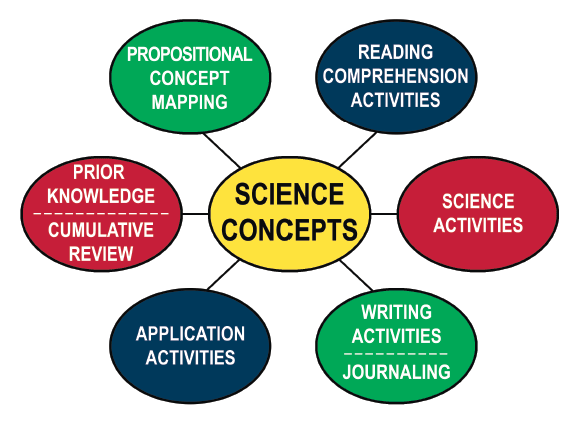
Figure 1: Science Concepts
Examples of Scientific Concepts:
- Planets: "My Very Educated Mother Just Served Us Nachos"
- Photosynthesis: The process by which green plants and some other organisms use sunlight to synthesize foods with the aid of chlorophyll.
- Evolution: The change in the heritable characteristics of biological populations over successive generations.
- Atomic Structure: The concept that all matter is composed of atoms, which consist of protons, neutrons, and electrons.
- Conservation of Energy: A principle stating that energy cannot be created or destroyed, only transformed from one form to another.
2. The Importance of Scientific Concepts
Scientific concepts are critical for several reasons:
- Framework for Understanding: They provide a structured way to understand and interpret various phenomena.
- Basis for Further Learning: Mastery of basic concepts is necessary for advancing in more complex scientific studies.
- Scientific Communication: They offer a common language for scientists to share and discuss ideas, findings, and theories.
- Problem-Solving: They enable the application of scientific principles to solve real-world problems.
3. How Scientific Concepts are Formed
Scientific concepts often begin as hypotheses—proposed explanations based on observations. Through experimentation and evidence gathering, these hypotheses can be refined into theories and laws:
- Observation: Noticing and describing phenomena in the natural world.
- Hypothesis: Forming a tentative explanation based on observations.
- Experimentation: Conducting controlled tests to support or refute the hypothesis.
- Theory Formation: Developing a coherent explanation that integrates the results of multiple experiments and observations.
- Law: A statement that describes an observable occurrence in nature that appears to always be true.
4. Challenges in Understanding Scientific Concepts
Understanding scientific concepts can be challenging due to their abstract nature and complexity. Some common difficulties include:
- Abstract Thinking: Many scientific concepts require thinking beyond tangible experiences.
- Mathematical Foundations: Some concepts, especially in physics and chemistry, involve complex mathematical equations.
- Interdisciplinary Nature: Scientific concepts often overlap multiple fields, requiring knowledge from various disciplines.
- Language Barriers: Specialized terminology can be a hurdle without proper foundational knowledge.
5. Teaching and Learning Scientific Concepts
Effective strategies for teaching and learning scientific concepts include:
- Hands-On Experiments: Practical experiments help students observe and understand concepts in action.
- Visual Aids: Diagrams, models, and animations can make abstract concepts more concrete.
- Analogies and Metaphors: Relating new concepts to familiar experiences can enhance understanding.
- Incremental Learning: Building knowledge step-by-step from simple to complex.
- Discussion and Collaboration: Group work and discussions can facilitate deeper understanding through shared insights.
II. Science vocabulary
1. Understanding Science Vocabulary
To fully engage with scientific texts and concepts, students must first understand the vocabulary that underpins the field. Scientific terminology often includes precise terms that describe complex processes, phenomena, and structures. These terms are not just labels but convey significant information about the nature of the concepts they represent. For example, the word “photosynthesis” combines “photo,” meaning light, and “synthesis,” meaning to put together, indicating a process that involves assembling components using light.
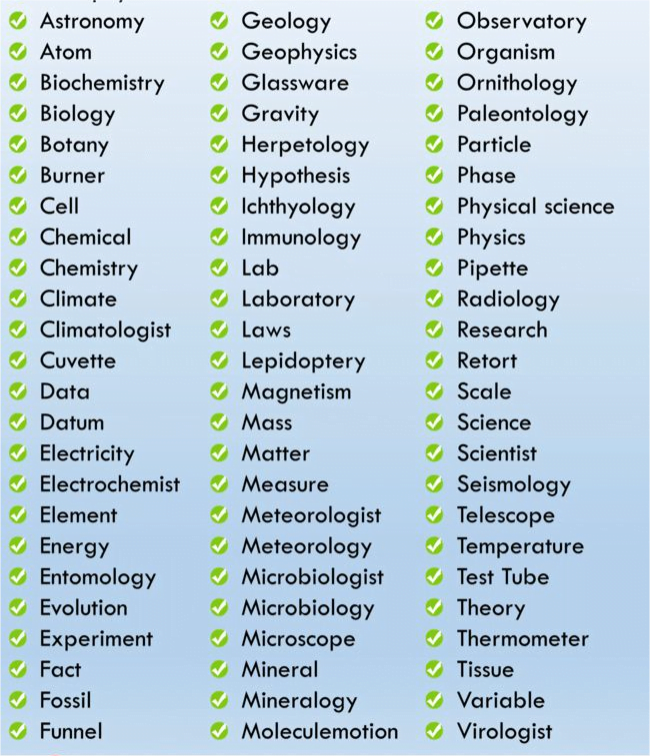
Figure 2: Flashcards
2. Common Science Terminology
Science is replete with terms that recur across various disciplines. Familiarity with these terms is essential for students to build a solid foundation in science. Here are a few examples:
- Atom: The basic unit of a chemical element, consisting of a nucleus surrounded by electrons.
- Molecule: A group of atoms bonded together, representing the smallest unit of a chemical compound.
- Ecosystem: A biological community of interacting organisms and their physical environment.
- Hypothesis: A proposed explanation for a phenomenon, made as a starting point for further investigation.
3. Descriptive Words in Science
Descriptive words in science help to provide clarity and detail about observations and phenomena. These words often describe qualities, quantities, and relationships:
- Quantitative: Relating to the measurement of quantity (e.g., numerical data).
- Qualitative: Relating to the quality or characteristics of something (e.g., descriptive data).
- Microscopic: Invisible to the naked eye and requiring a microscope to be seen.
- Macroscopic: Visible to the naked eye.
4. Exploring Word Parts
Understanding the structure of scientific terms can significantly enhance vocabulary comprehension. Scientific terms often consist of roots, prefixes, and suffixes, each contributing to the overall meaning of the word.
- Roots: The core part of the word that contains the basic meaning. For example, "bio" means life, as seen in "biology" (the study of life).
- Prefixes: Added to the beginning of a root word to modify its meaning. For example, "hypo-" means under or below, as in "hypothermia" (below normal body temperature).
- Suffixes: Added to the end of a root word to alter its meaning or indicate its part of speech. For example, "-logy" means the study of, as in "geology" (the study of the Earth).
III. Why Science Terminology is Difficult
Scientific terminology can be challenging for several reasons:
- Complexity: Many scientific terms are long and complex, making them difficult to pronounce and remember.
- Specialization: Scientific vocabulary is often highly specialized, with terms that are not used in everyday language.
- Foreign Roots: Many terms are derived from Latin or Greek, languages that may be unfamiliar to students.
IV. Dissecting Science Vocabulary
Dissecting science vocabulary involves breaking down complex terms into their component parts to understand their meanings better. This approach can make seemingly incomprehensible words more accessible. For instance, the word “photosynthesis” can be dissected into “photo-” (light) and “-synthesis” (putting together), revealing its meaning as a process that involves putting together components using light.
Many scientific terminology are generated by combining various word elements that are typical of Greek or Latin origin. The Greek language is utilised since so many pioneering scientists and researchers were Greek, which had a greater influence on scientific nomenclature than English did. Similarly, English is not utilised because scientific discoveries and ideologies, as well as the roots of the western science community to which terminology refer, occurred outside of English-speaking countries. Latin was an international language during the era of scientific discovery in Europe and the expanding western world. Thus, scientific words have been preserved in Greek and Latin until this day. Some Greek and Latin terms appear in science language, such as apoptosis, biology, and centrifugation.
To explain the origins of scientific jargon, the term apoptosis can be disassembled to determine its meaning. When discussing cellular death, the term “apoptosis” is employed, which originates from Greek and means “falling off”. Because there is no suffix, this word can be divided into prefixes and roots. The prefix “apo-” means “separating,” while the root “-ptosis” means “falling off”. When a cell dies, it divides into smaller fragments. So, given the Greek origin and the meanings of the root and prefix in the name apoptosis, it makes sense because the cell fragments when it dies.
Common Science Terms
Science is a field rich with specific terminology that describes various concepts, processes, and phenomena. Familiarity with these terms is essential for students to understand scientific literature and engage in discussions. Here are some common science terms that are frequently encountered:
Basic Units and Concepts
- Atom: The smallest unit of a chemical element that retains its chemical properties.
- Molecule: Two or more atoms bonded together, representing the smallest unit of a compound.
- Element: A pure substance consisting entirely of one type of atom.
Biological Terms
- Cell: The basic structural and functional unit of all living organisms.
- DNA (Deoxyribonucleic Acid): The molecule that carries genetic information in living organisms.
- Photosynthesis: The process by which plants and other organisms convert light energy into chemical energy.
- Ecosystem: A community of living organisms interacting with their physical environment.
- Biodiversity: The variety of life in the world or in a particular habitat or ecosystem.
Physical Science Terms
- Force: An interaction that causes a change in an object's motion.
- Energy: The capacity to do work or produce change, existing in various forms such as kinetic, potential, thermal, and chemical.
- Mass: The amount of matter in an object, typically measured in kilograms or grams.
Chemical Terms
- Compound: A substance formed when two or more chemical elements are chemically bonded together.
- Reaction: A process in which substances (reactants) are transformed into different substances (products).
- Catalyst: A substance that increases the rate of a chemical reaction without being consumed.
Earth Science Terms
- Plate Tectonics: The theory explaining the movement of the Earth's plates and the resulting geological activity.
- Sedimentary Rock: Rock formed from the accumulation of sediment, usually in layers.
- Weathering: The breakdown of rocks and minerals at the Earth’s surface due to atmospheric conditions.
V. Study Skill Help Your Students Decode Science Vocabulary
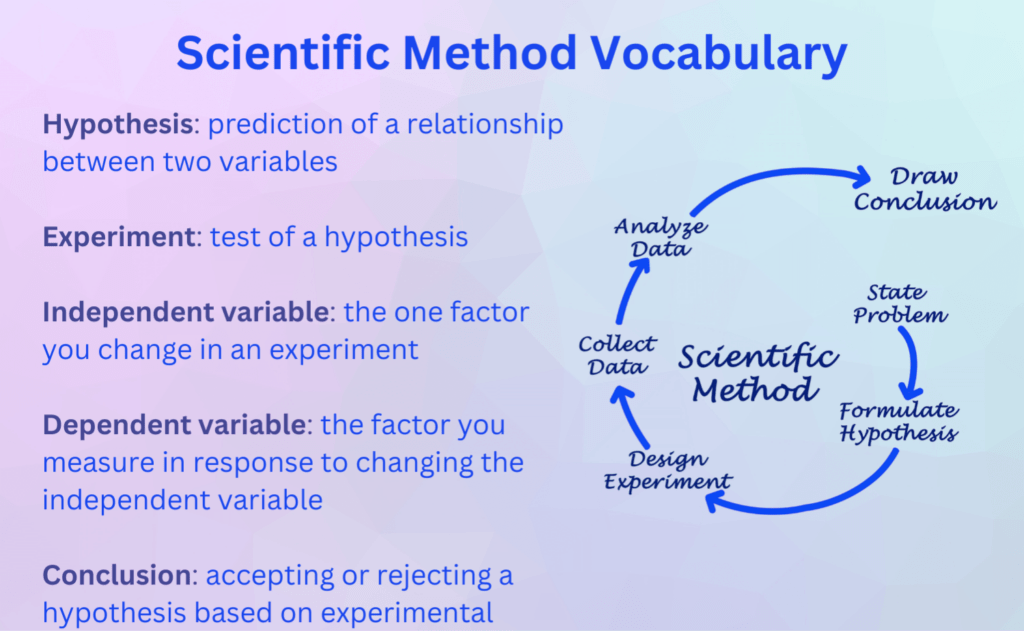
Figure 3: Scientific Method Vocabulary
Here are some strategies to help students decode scientific vocabulary:
- Teach Word Parts: Familiarize students with common roots, prefixes, and suffixes.
- Context Clues: Encourage students to use context clues from surrounding text to infer the meaning of unknown terms.
- Practice and Repetition: Reinforce new vocabulary through repeated exposure and practice.
- Visual Aids: Use diagrams and visual aids to illustrate complex terms and concepts.
VI. FAQs
1. What are some common science prefixes and their meanings?
Some common prefixes include “hyper-” (above or excessive), “hypo-” (under or below), “inter-” (between), and “intra-” (within).
2. How can I improve my scientific vocabulary retention?
Regular practice, using flashcards, engaging in discussions, and applying terms in different contexts can improve retention.
3. Are there resources available to help with understanding scientific terminology?
Yes, many online resources, such as vocabulary lists, educational websites, and apps, are designed to help students learn scientific terms.
Conclusion
Understanding scientific concepts and vocabulary is crucial for success in science education. By breaking down complex terms into their roots, prefixes, and suffixes, students can gain a clearer understanding of their meanings and applications. This lesson has provided an overview of common scientific terminology, descriptive words, and strategies for decoding and learning new vocabulary. With these tools, students can approach scientific texts and concepts with greater confidence and comprehension, paving the way for a deeper engagement with the subject.