


Lesson 1 – Information System
Introduction
I admit it “information systems” is one of the most ambiguous expressions I’ve ever heard. What initially came to mind was massive amounts of data, and after some study, I discovered that my assumption was not far off. This broad word in business refers to several factors that contribute to organisational success.
So, what is an information system? In this session, I’ll explain what goes into this crucial collection of tools and how to create your own information system plan.
I. What is information systems?
Information systems refer to the technologies that organisations employ to acquire, handle, and analyse data. This data informs decision-making for increased efficiency and profitability.
Every choice an organisation takes should be data-driven, therefore information systems may be used for a variety of purposes, including human resource management, financial account management, consumer outreach and advertising, competitive landscape research, and more.

What is an Information System.mp4
Examples for information systems:
Information systems may benefit almost every corporate process, but here are a few practical applications.
AI is increasingly being used in information systems to mimic human problem-solving abilities, such as Siri. Expert systems employ knowledge that would normally be supplied by a subject matter expert to solve issues and make judgements. In the corporate world, it may fix accounting difficulties or detect viruses.
Office automation systems save time by automating repetitive operations. Office automation systems bring together computer and communication technologies with human resources to implement more efficient operations. For example, a COO may send out monthly company-wide email updates that incorporate AI-generated status reports.
Process control systems are an effective technique to integrate information systems with product manufacturing. They create specified outputs based on sensor inputs and are typically used to confirm that a product fulfils certain standards. A thermostat is a basic example: when the temperature drops below a set threshold, the heat kicks on. If you manufacture a physical product that is frequently criticised by clients, you should consider improving your process controls.
II. 5 components of information systems
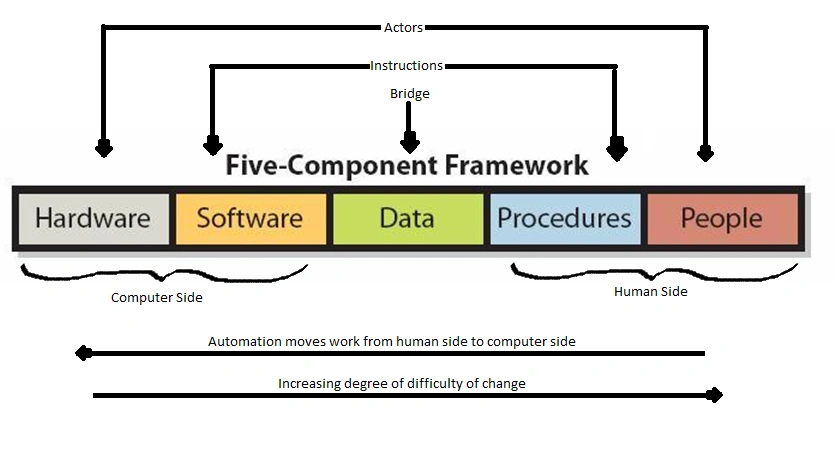
So, what goes into an information system? Almost everything required for a productive modern office: technology, software, data, communication, and people. Almost every information system contains these components in some fashion.
1. Hardware
Computers are the actual devices that comprise information systems. Nowadays, this doesn’t only refer to your cubicle’s desktop or laptop computer; we often have computers at our fingertips while we aren’t tapping away on our keyboards. Smartphones, tablets, and smart watches can store, access, and manage large quantities of data.
You may also split down hardware into its components: hard drives for storage, microprocessors for processing power, graphics cards for graphics generation, monitors for display, and so on.
2. Software
Computers are essentially gleaming black mirrors without the programmes that instruct the hardware what to perform. Software may be divided into two types:
- System software, which allows you to control your computer’s data and general interface (think Windows 10).
Application software refers to programmes that handle specific tasks (such as Google Sheets and Microsoft Outlook). System software serves as a foundation for application software development.
Software can be either open or closed source. Open-source software encourages cooperation since users may alter the code to change how it works. Closed-source software is proprietary, which means that the owner controls the user’s ability to alter it.
3. Data Sources
Data represents “information” in information systems.Databases and data warehouses hold qualitative and quantitative information that users and software may access, analyse, and alter.
Databases store information that users need on a regular basis to perform vital tasks, such as storing and retrieving file contents. Data warehouses store and analyse data from many sources across time to make informed decisions. A data warehouse, for example, may contain unified client data from your POS system, mailing list, and cookies.
4. Telecommunications
Telecommunications refers to how computers communicate with one another. The internet may be the first thing that comes to mind, and you are correct. However, telecommunications may be split down further.
Some connections are physical, such as coaxial and fiber-optic cables that telephone, internet, and cable companies utilise to transport data. Others use wireless networks, such as local area networks (LANs) and wide area networks (WANs). Microwaves and radio waves are also unseen conduits that carry data between devices.
Telecommunications allows users to access data via the cloud; without these technologies, all data would have to be kept on a single device.
5. Human Resources
While automation is replacing tiresome work with robots, it has not yet led to a Westworld-like android takeover. Human specialists who can analyse and manipulate data are critical to any information systems strategy.
Business analysts utilise data to improve operations, including efficiency and resource allocation. Similarly, information security experts hunt for security flaws to lessen the risk of cyberattacks.
Analysts can use technology such as business intelligence to make strategic judgements based on data, rather than doing everything manually.
Curating a holistic information system strategy requires time and effort.
- Determine your company’s objectives and information needs.
You should base your approach on your aims. When in doubt, go to your KPIs. Which benchmarks are you failing to meet? For example, suppose you actively sell yourself as a customer-friendly solution, but a survey indicates customer satisfaction is 20% lower than your benchmark.
Once you’ve identified an aim like this, determine what information you’ll need. Have you been gathering client information in a database or data warehouse? Do you have enough to create a client retention and satisfaction strategy? If not, start from scratch and actively collect client data.
- Plan how you will improve your current system.
Refine your existing information systems infrastructure. For example, you may have a lot of client data in a data warehouse but no customer relationship management (CRM) software.
This provides a chance to customise CRM software based on existing data. When considering how to enhance your system, keep the budget and other resources in mind. Not every plan is affordable.
- Design and implement your new system.
During this phase, you’ll compile a set of specs and criteria that your system must meet, which will differ based on your company’s demands. For example, consider the following questions:
- o How will you gather, consolidate, and access data?
- o What software do you require, and how will you customise it?
- o Should the hardware be changed to support new software?
- o How will your applications integrate?
- o Which components of your system will be automated rather than handled by humans?
- o Who will manage your information systems? CIO, CTO, or another role?
Your team should then develop the functionalities that will bring your system to life. Once you’ve finished designing everything, it’s time to buy and install your new mechanisms. This procedure can be costly and time-consuming; after all, you are replacing your whole organization’s status quo. Before implementing the system throughout your organisation, ensure that it works as expected.
When updating your system, it’s important to document and secure any changes. Your engineers should also devote a significant amount of effort to understanding the demands of the people who will be utilising the system the most. Otherwise, they may squander time developing ineffective functionalities.
III. Types of information systems
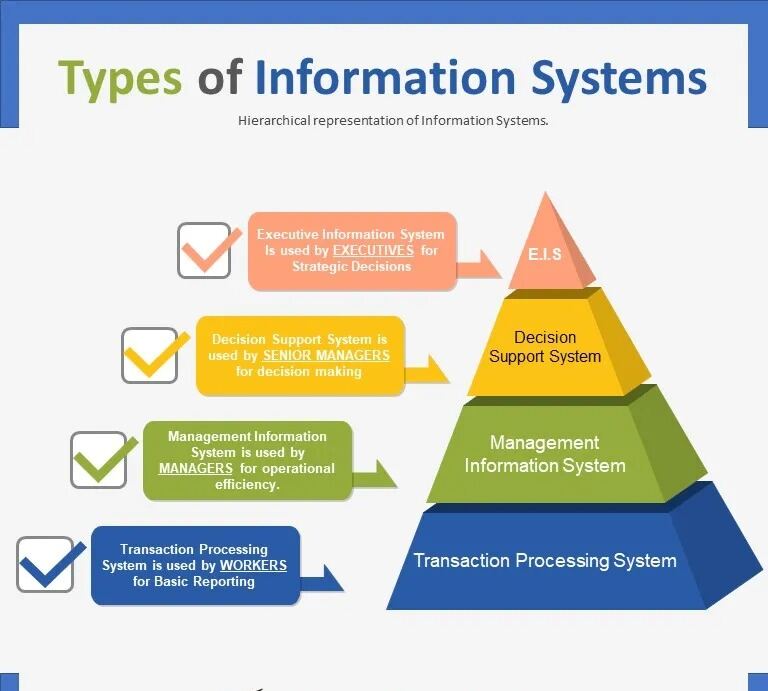
There are numerous information systems, and the sort of information system used by a firm is determined by its goals and objectives. There are four major types of information systems:
- Operations support systems – The first sort of information system is an operational support system. This sort of information system is primarily designed to assist a certain business process. An example is the transaction processing system utilised by all banks globally. This sort of information system allows service providers to evaluate a certain business process.
- Management information systems – This is the second type of information system, which consists of hardware and software integration that allows the organisation to fulfil its primary duties. They assist in gathering information from numerous web systems. The system does not save the data acquired; rather, it analyses it in a productive manner to aid in organisational administration.
- Decision support systems enable organisations to make educated decisions regarding their operations. It evaluates quickly changing data that cannot be predicted in advance. It may be employed in both fully automated and human-operated systems. However, for optimal efficiency, a mix of human and computer-operated devices is advised.
- Executive information systems (EIS) or executive support systems are the final category of management support systems. They assist in making senior-level choices for an organisation.
IV. Why your organization needs information systems
Data-driven decision-making relies heavily on effective information systems. It enables organisations to make sense of massive amounts of data and apply that knowledge to discover and remedy process errors. Without it, your organisation would be locked in the same inefficiencies that keep it back.
For example, by enhancing its information systems strategy, a company may centralise its information resources, reducing confusion and transforming a disorganised workplace into a well-oiled machine. This increases staff and consumer satisfaction.
Conclusion
Information systems exist at the interface of technology, people, and procedures inside an organisation. Any information system consists of three basic components. Technology encompasses hardware, software, data, and network communications. People are also an important component of information systems, including help desk personnel, programmers, the CIO, and other essential actors in the information systems department. Finally, a process is a set of actions taken to accomplish a goal. Processes and information systems should always be in line with the company’s aims.