


Lesson 1 – Commutative Property of Addition
Introduction
Welcome to this lesson on Understanding the Commutative Property of Addition. Addition is a fundamental mathematical operation used in everyday life, from simple arithmetic problems to complex calculations. The commutative property of addition is a concept that is essential to understanding and mastering addition.
In this lesson, we will explore the commutative property of addition, how it works, and why it’s important. By the end of this lesson, you will have a thorough understanding of this property and be able to apply it to various mathematical problems. So, let’s get started with understanding the commutative property of addition!
I. Definition
1. Addition
Before starting the lesson, the teacher needs to review the concept of addition and how to add two numbers together. To do this, the teacher needs to give some examples.
Example 1: Suppose you have 3 apples and 2 oranges. How do you find the total number of fruits you have?
Solution: You add 3 and 2, and you get 5.
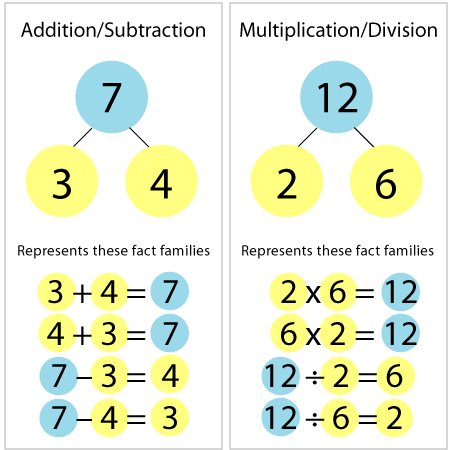
This can also be an excellent time to introduce vocabulary words associated with addition, such as “sum” and “addends.”
Ask the student to solve the questions 2 + 3 = ___ and 3 + 2 = ___. By that, ask them the difference between the two questions or if they still get the same answer.
2. Commutative property
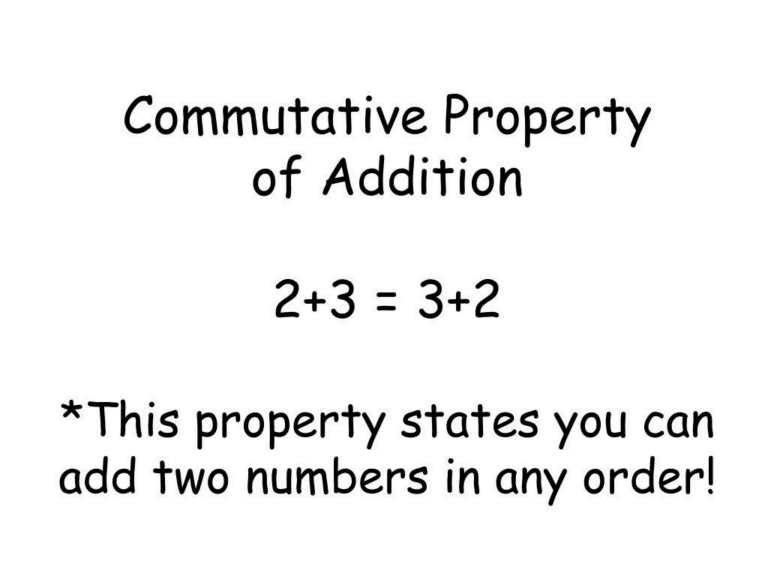
The commutative property is a mathematical property that applies to binary operations, such as addition and multiplication. It states that changing the order of the operands does not change the result.
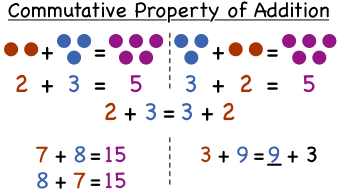
For example, the commutative property states that a + b = b + a, and in multiplication, it states that a x b = b x a. The commutative property is a fundamental in mathematics widely used in various fields of study.
The term “commute” refers to the act of traveling or moving around. On the other hand, the commutative property of addition asserts that altering the order of the numbers being added will not impact the sum. In other words, the commutative property of addition can be defined as adding numbers in any sequence that will yield the same outcome.

During this time, the teacher can use addition flashcards or number cards to demonstrate the property, such as showing 2 + 5 = 5 + 2.
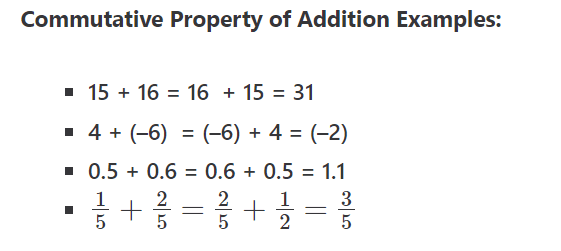
Or give them some examples:
II. Guided Practice:
In 15 minutes, students have to work in pairs to complete a worksheet with addition problems. But before they begin, remind them to use the commutative property of addition if needed.
Example 1: Let ‘X’ be 4, and ‘Y’ be 9. Find the sum of the numbers using the commutative property of addition.
Solution: We are given X = 4 and Y = 9. Therefore,
X + Y = 4 + 9 = 13
Y + X = 9 + 4 = 13
Example 2: Let ‘X’ be 10, and ‘Y’ be 7. Find the sum of the numbers if they change their position.
Solution: We are given X = 10 and Y = 7. We know that, in addition, the commutative property is true,
X + Y = 10 + 7 = 17
Circulate the room and assist in checking the answer the whole class.
III. Independent Practice:
For the next 15 minutes, pass out a sheet of paper and pencil to each student. Ask them to write five addition problems and swap pieces with a partner. And then, their partner will use the commutative property of addition to rewrite the problem in a different order and solve it. After all, students will check their partner’s work and then switch roles.
Conclusion
In conclusion, the commutative property of addition is an essential mathematical concept that states that the order of the addends does not impact the sum. This implies that the outcome will remain unchanged if we rearrange the added numbers. Students must master the commutative property of addition because it serves as the foundation for more difficult mathematical operations. Students can simplify the acquisition and other mathematical operations by comprehending and using this fact, making it simpler to solve problems correctly and quickly.