


Lesson 7 – How to Measure Objects in the Sky
Introduction
To ensure a thorough understanding of measuring objects in the sky, it is important to begin the lesson with an informative introduction. This will establish a solid foundation for students to comprehend the importance and methods involved in measuring celestial bodies.
I. Angles and Degrees
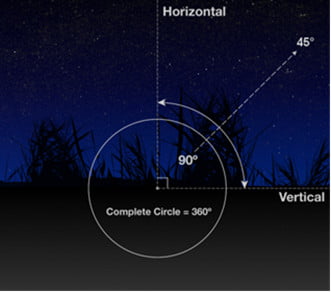
In the field of astronomy, a crucial skill is the ability to accurately measure objects in the sky. Astronomers rely on angles and degrees as their primary tools for this task. When we gaze up at the night sky, we often see various celestial bodies like stars, planets, and constellations. To determine their positions, astronomers use a unit of measurement called degrees. To visualize this, imagine drawing an imaginary line from your eye to an object in the sky, and then another line from your eye to the horizon. The angle between these two lines is measured in degrees. By measuring these angles, astronomers can pinpoint the exact location of celestial objects, which aids in understanding their behavior and movements.
Furthermore, angles and degrees play a crucial role in determining the size of objects in the sky. Let’s take the moon as an example. We often hear that the moon has a diameter of about 3,474 kilometers, but how do astronomers know this? They employ a technique called angular diameter. By observing and measuring the angle formed by the moon, they can calculate its actual size. This is achieved by comparing the angular diameter of the moon to that of a known object, such as the sun or a distant star. Through this method, astronomers can accurately measure the size of celestial objects, providing valuable insights into the vastness of our universe.
In conclusion, the ability to measure objects in the sky using angles and degrees is essential for astronomers. By measuring the angles between an observer’s eye and celestial objects, astronomers can determine their positions and track their movements. Additionally, the use of angular diameter allows scientists to accurately calculate the size of objects in the sky. These techniques are vital for exploring the wonders of the universe and advancing our knowledge of the cosmos.
II. Angular Distance and Size
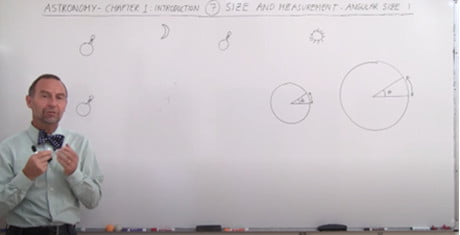
Measuring objects in the sky is a crucial aspect of astronomy. Scientists rely on two main concepts, namely angular distance and angular size, to determine the positions of celestial objects. Angular distance refers to the separation between two objects in the sky, while angular size describes the apparent size of an object as seen from Earth. Astronomers use units like degrees or arcminutes to measure angular distance. For example, if two stars appear to be 5 degrees apart, it means there is an angular distance of 5 degrees between them. This measurement aids astronomers in accurately locating and mapping celestial objects.
On the other hand, angular size helps us determine the perceived size of an object in the sky. It is important to note that the angular size of an object depends on both its actual size and its distance from Earth. For instance, the Moon and the Sun have different sizes, but they appear to be roughly the same angular size in the sky because the Moon is much closer to us. Scientists can estimate the actual size of an object if they know its distance and angular size. By utilizing these measurements, astronomers can gain a better understanding of the nature and characteristics of celestial bodies in our vast universe.
Conclusion
In conclusion, the lesson on measuring objects in the sky proved to be an invaluable and enriching learning experience for the students. Through hands-on activities and detailed explanations, they gained a profound understanding of celestial measurements and the tools used by astronomers to track and analyze astronomical objects. This lesson not only enhanced their grasp of fundamental concepts in astronomy but also ignited their curiosity and appreciation for the vastness and complexity of the universe. By engaging with these practical techniques, students were able to connect theoretical knowledge with real-world applications, fostering a deeper and more lasting comprehension of the subject matter.