


Lesson 6 – Financial Markets
Introduction
In summary, maximizing profits is the main objective of financial management. The practice of evaluating and making the most use of the resources that are available to maximize earnings is known as profit maximization. For stockholders of the company looking for the best return on their investment, this provides the biggest advantages.
I. Types
1. Stock Markets

Stock markets are among the most common financial marketplaces. These are the places where businesses offer their shares for purchase and sale by investors and traders. Companies utilize stock markets, often referred to as equities markets, to obtain cash through initial public offerings (IPOs). Shares are then sold in what is referred to as a secondary market between different buyers and sellers.
Stocks can be traded over-the-counter (OTC) or on public platforms like the Nasdaq or the New York Stock Exchange (NYSE). The majority of stock trading occurs on regulated exchanges, which are crucial to the economy because they serve as indicators of the state of the economy as a whole and as sources of dividend income and capital gains for investors, particularly those with retirement accounts like 401(k) and IRAs.
Retail and institutional investors, traders, market makers (MMs), and specialists who uphold liquidity and offer two-sided markets are typical participants in the stock market. Brokers are impartial third parties who help buyers and sellers complete trades; they never actually purchase shares.
2. Over-the-Counter Markets
The over-the-counter (OTC) market is a decentralized market where participants exchange securities directly between two parties without the use of a broker. It lacks physical locations and is entirely electronic. The majority of stock trading occurs through exchanges, while OTC markets may handle trading in specific equities (such as smaller or riskier companies that may not meet the listing requirements of exchanges). However, some derivatives markets are only over-the-counter (OTC), and as such, they constitute a significant portion of the financial markets. OTC markets and the transactions that take place in them are generally more opaque, less liquid, and less regulated.
3. Bond Markets
A bond is an asset that allows investors to make fixed-term loans of money at predetermined interest rates. A bond can be viewed as a contract outlining the terms of the loan and the borrower’s obligations from the lender. To fund initiatives and operations, firms, states, and federal governments all issue bonds. Securities like notes and bills issued by the US Treasury, for instance, are sold on the bond market. The debt, credit, or fixed-income market are other names for the bond market.
4. Money Markets
The money markets often deal in highly liquid securities with short maturities (less than a year) that offer a modest interest rate of return in combination with a high level of safety. The money markets involve high-volume trades between dealers and institutions at the wholesale level. These include money market accounts opened by bank clients and money market mutual funds purchased by private investors at the retail level. Purchasing short-term certificates of deposit (CDs), municipal notes, or U.S. Treasury bills are a few alternative ways that individuals might participate in the money markets.
5. Derivatives Markets
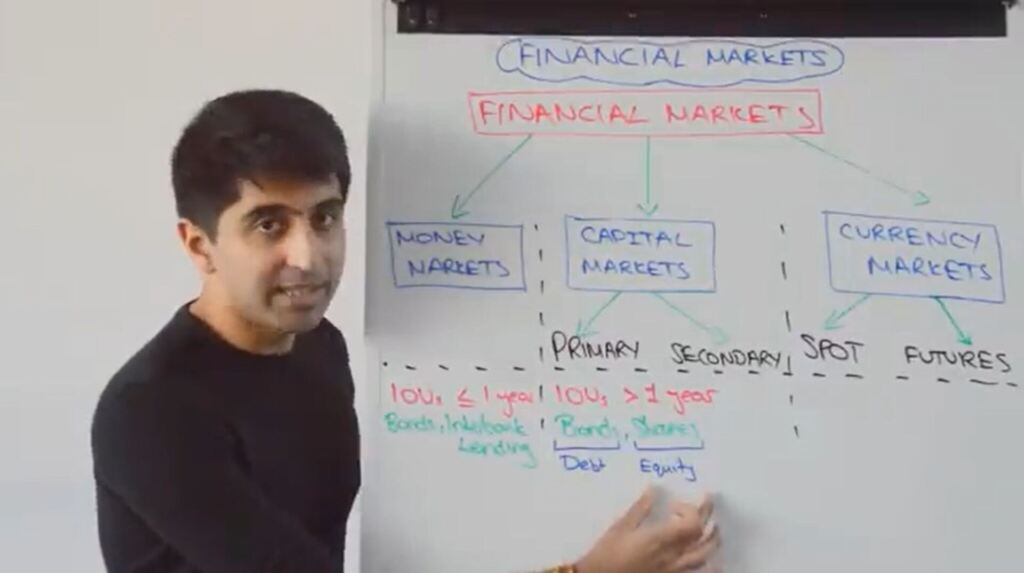
A derivative is a financial agreement that involves two or more parties and is based on an agreed-upon collection of assets (such as an index) or an underlying financial asset (such as securities). Secondary securities known as derivatives derive their entire value from the value of the parent security to which they are tied. A derivative is worthless by itself. In the derivatives market, traders trade complex financial products such as futures and options contracts, which are derived from underlying instruments such as stocks, bonds, commodities, currencies, interest rates, and market indexes, instead of directly trading equities.
Futures contracts are listed and sold on futures exchanges. Futures markets have defined contract specifications, are well-regulated, and use clearinghouses to settle and confirm deals, in contrast to forwards, which trade over the counter. Similar to this, options markets that list and oversee options contracts include the Chicago Board Options Exchange (CBOE). Exchanges for futures and options may list contracts on a range of asset types, including commodities, fixed-income securities, stocks, and more.
6. Forex Market
The market where players can purchase, sell, hedge, and speculate on the exchange rates between currency pairings is known as the forex (foreign exchange) market. Since currency is the most liquid asset, the foreign exchange market is the most liquid in the entire globe. Daily transactions in the currency market exceed $7.5 trillion, surpassing the total volume of transactions in the equity and futures markets.
The forex market is decentralized and made up of a global network of computers and brokers from all over the world, just like the OTC markets. Banks, businesses, central banks, hedge funds, investment management companies, and individual currency traders and investors comprise the forex market.
7. Commodities Markets
Commodities markets are locations where producers and consumers come together to trade tangible goods like energy products (oil, gas, carbon credits), agricultural products (corn, cattle, soybeans), precious metals (gold, silver, platinum), or “soft” commodities (cotton, coffee, and sugar). These exchanges of tangible goods for cash are referred to as spot commodity markets.
However, the majority of trading in these commodities occurs on derivatives markets where the underlying assets are spot commodities. Commodity forwards, futures, and options are traded over-the-counter (OTC) as well as on listed exchanges across the globe, including the Intercontinental Exchange (ICE) and the Chicago Mercantile Exchange (CME).
8. Cryptocurrency Markets
The emergence and growth of decentralized digital assets built on blockchain technology, such as Bitcoin and Ethereum, have occurred during the past few years. Thousands of cryptocurrency tokens are now available and traded on a variety of independent online cryptocurrency exchanges throughout the world. These exchanges allow traders to exchange one cryptocurrency for another or fiat money like dollars or euros by hosting digital wallets.
Users of most cryptocurrency exchanges are vulnerable to fraud and hacking since these platforms are centralized. There are also decentralized exchanges that function without a central authority. Through these exchanges, digital currency transactions can be conducted directly between peers (P2P) without the assistance of a real exchange authority. Major cryptocurrencies also provide options and futures trading.
II. Characteristics of the Financial Market
A strong financial market has the following features in addition to turning savings into capital, allocating that capital for investments, and facilitating immediate cash liquidity. Examine the following points to have a deeper understanding of the financial market’s function.
- ● Enables the immediate cash availability that many firms need, such as in the retail sector during big holidays or in the agricultural sector during harvest season.
- ● The ability to swiftly sell their financial assets for cash when needed or desired is one of liquidity's benefits to investors.
- ● Aids in the process of price discovery, which ascertains the fair price of a security, commodity, good, or service by utilizing the forces of supply and demand in a competitive market: Pricing is therefore a useful tool for demonstrating where money is being spent most profitably.
- ● diversifying assets and adjusting individual investors' risk tolerance to the risk characteristics of various investments, facilitates risk sharing and risk control.
- ● Designed to minimize transaction costs. Accurate, publicly available information must be gathered and distributed via the market.
- ● Loan guarantees from borrowers must be reliable.
III. FAQs
1. What Kinds of Financial Markets Are There?
The stock market, bond market, FX market, commodities market, and real estate market are a few instances of financial markets and their functions. In addition, capital markets, money markets, listed versus OTC markets, and primary versus secondary markets can be distinguished within the financial markets.
2. How Are Financial Markets Operational?
The fundamental function of all financial markets, despite their wide range of asset classes, structures, and rules, is to connect buyers and sellers of various assets or contracts and enable them to transact with one another. A price-discovery process or auction is frequently used for this.
3. What Are The Financial Markets' Principal Purposes?
Although there are other reasons why financial markets exist, their primary purpose is to facilitate the effective distribution of capital and assets within a financial economy. The financial markets help the world economy function more smoothly by providing a free market for the flow of capital, financial obligations, and money. They also enable investors to gain from capital gains over time.
4. What Makes the Financial Markets Crucial?
Financial markets are necessary for the efficient allocation of capital, yet they also significantly reduce the amount of economic activity that includes trade, investments, and growth opportunities.
5. Who makes up the Main Financial Market Participants?
Businesses raise money from investors through the stock and bond markets. Traders utilize futures markets to hedge against different risks, arbitragers try to profit from mispricings or anomalies seen in different markets, and speculators look to a variety of asset classes to place directed bets on future prices. In exchange for their services, brokers frequently serve as middlemen between buyers and sellers, charging a commission or other charge.
Conclusion
Financial markets allocate resources and provide liquidity for companies and entrepreneurs, which is essential to the proper operation of capitalist economies. Trading financial holdings is made simple for buyers and sellers by the markets. Financial markets produce securities products that give returns to lenders and investors who have extra money, and they also make that money available to borrowers who need more money.