


Lesson 1 – Corporate Finance
Introduction
How companies finance their activities to maximize profits and minimize expenses is the focus of corporate finance. It addresses both short-term financing objectives (like issuing bonds) and long-term demands on firm cash flows.
I. Direct Cash Flow Method

A branch of finance known as “corporate finance” studies how businesses handle capital structures, investment choices, accounting, and funding sources.
Maximizing shareholder value through both short- and long-term financial planning and applying various methods is a common topic in corporate finance. Tax considerations and capital investments are examples of corporate finance activity.
II. The Fundamentals of Corporate Finance
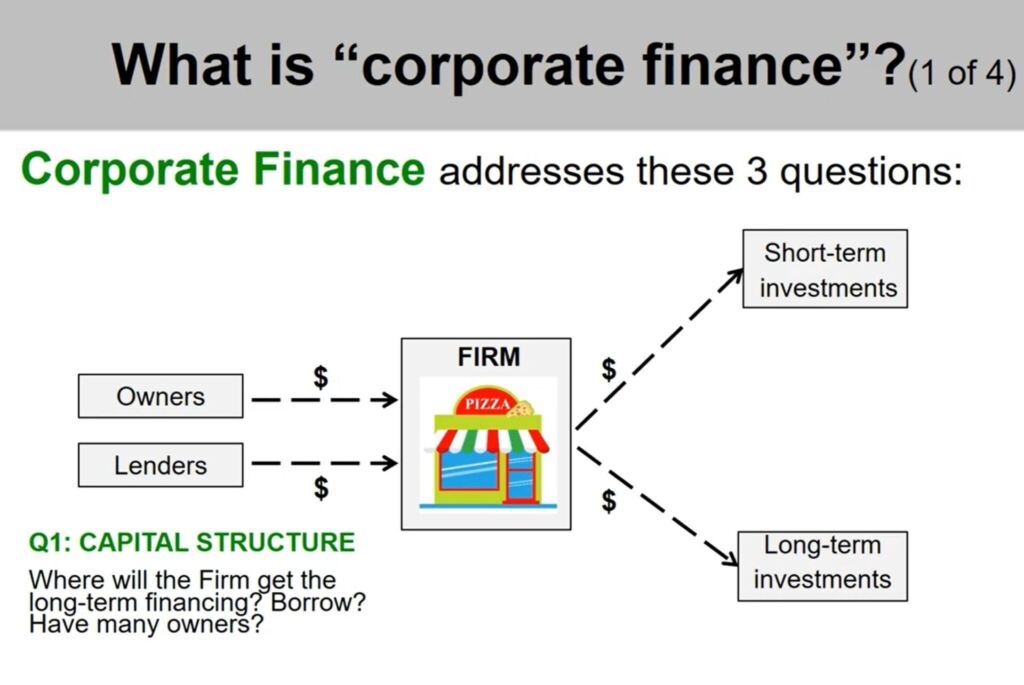
Three guiding concepts or domains of endeavor that collectively include the entire scope of corporate finance comprise the field of corporate finance. The following are the fundamentals of corporate finance:
- ● Capital budgeting
- ● Capital financing
- ● Reinvestments and dividends
1. Capital budgeting
Capital budgeting refers to the practice of organizing business investments. Careful planning is required for the corporate finance activity of capital budgeting to guarantee the maximum returns for a company’s long-term capital assets.
To ensure that investment decisions are always based on careful financial analysis, firms consult with a range of advisory professionals and accountancy tools. They assess the available cash generated by any potential financial projects and identify chances for capital expenditures with the assistance of corporate finance specialists.
This type of financial modeling estimates the expected revenue and plans out the desired expenses for a specific investment, helping to decide whether or not to invest. In corporate finance, the capital budgeting phase typically involves comparing the estimates of several similar possibilities to determine which is most suited for investment.
2. Capital financing
The capital financing activity involves determining the most effective strategy to finance the investment opportunities identified during the corporate finance capital planning phase.
Either debt or equity may be used to finance the capital expenditures, or occasionally both. Selling stock to raise money for investments is another alternative, as issuing debt instruments through investment banks. These latter choices are particularly helpful for substantial or long-term capital expenditures.
If a precise corporate finance journal is not maintained to track the debt and equity involved in financing investments, this activity may become troublesome. To lower the danger of default, a corporate finance advising specialist will always advise making sure debt is kept to a minimum. Additionally, the amount of equity involved must be managed because using too much might negatively impact the company’s income and the original investors’ view of the business’s worth.
3. Reinvestments and dividends
A company’s corporate finance specialists will also determine what to do with the capital return. The excess money from profitable ventures can be used to finance the company’s operations or return to new ventures.
Paying dividends to shareholders from the extra money is an additional choice. Shareholders gain from this, but there are other ways as well. If additional revenue is retained in the company, it can expand and raise the overall value of the initial shares.
The most economically feasible course of action will typically determine whether to use the funds to expand the company, reinvest them in new ventures, or distribute dividends to shareholders. Retaining the money will be the best course of action if it can generate an investment rate of return greater than the cost of capital.
Conclusion
In conclusion, it should be noted that corporate finance is a subfield of finance. It deals with appropriate budgeting, obtaining funding through debt and/or equity to meet business needs and objectives, and effectively managing a company’s present assets and liabilities. Many positions in corporate finance have high compensation.