


Lesson 5 – Scientific Notation and Significant Figures
Introduction
Scientific notation and significant figures are two basic concepts in physics that help deal with measurement uncertainty. Because no experimental measurement can be precise, we will explore scientific notation and influential figures in this lesson and understand their definitions and rules.
I. Scientific Notation
1. Definition:
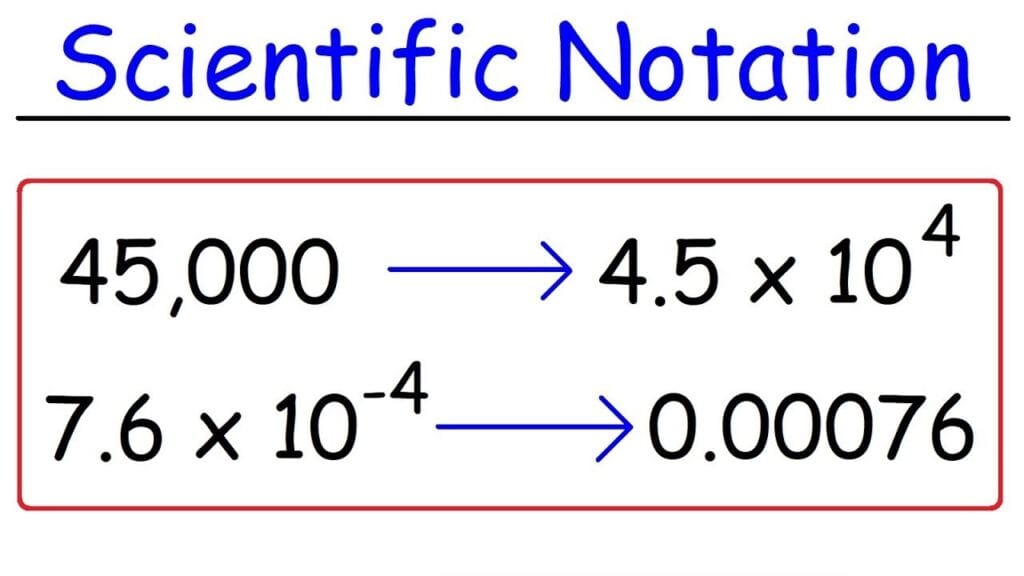
Scientists employ a shorthand technique known as scientific notation when dealing with extremely large or small numbers. In scientific notation, a number is represented as the product of a power of ten and a number between 1 and 10. This method allows for a concise representation of numbers, minimizing the need for excessive zeros.
Scientific notation
For example, the distance between the Earth and the moon, which is 384,000,000 meters, can be expressed as 3.84×10⁸ m. This method of representing the number is an example of scientific notation.
2. Rules
When converting a number from standard form to scientific notation, all numbers can be represented in N x 10n. “N” is a number between 1 and 10, an integer or a decimal. And “n” represents a positive or negative integer.
In standard form, there should be only one digit to the left of the decimal point in the number N. For example, 1.23×10⁶ is in common form while 123×104 is not.
If the number is less than 1, the exponent in scientific notation will always be negative. For instance, 0.000028 can be expressed as 2.8 x10⁻⁵.
If the number is greater than 1, then the exponent in scientific notation will be positive. For example, 13,000,000 can be expressed as 1.3 x10⁷.
II. Significant Figures
1. Definition:
Significant figures contribute to a given number’s overall value and meaning. Rounding is often employed to eliminate non-significant figures, but avoiding losing precision during the process is essential. In many cases, rounding is done to simplify numbers. To assist with rounding, a rounding calculator can be used.

Significant figures
2. Significant figures rules:
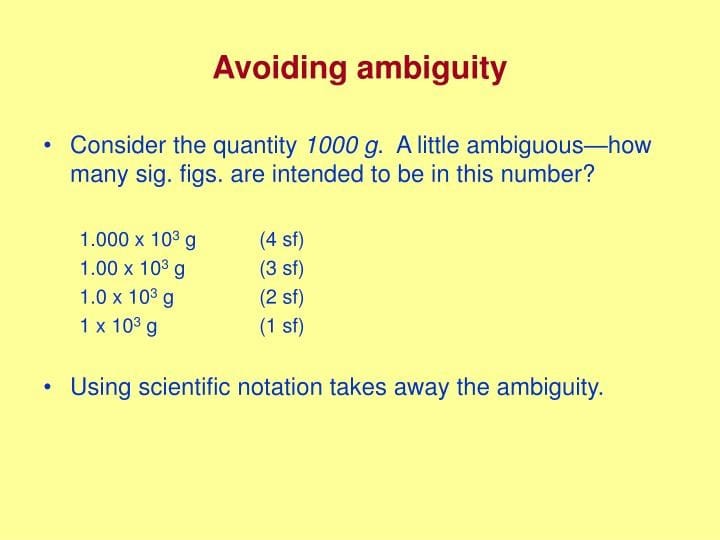
Here are the rules that govern significant figures, ensuring accurate representation and interpretation of data:
Avoiding ambiguity
- Non-zero digits are always considered significant. For example, 1.123 has four significant digits.
- Zeros between two significant digits are also substantial. For example, 1.05501 has six significant numbers.
- Zeros before the decimal point act as placeholders and are insignificant. In the number .00289, only the 2,8 and 9 are significant, resulting in three influential figures.
- Zeros that appear after the decimal point and after significant digits are significant. The number 0.2140, the digits 2, 1, 4, and the last 0 are substantial.
- Exponential digits in scientific notation are not considered significant. For example, 1.32x10³ has three significant numbers (1, 3, and 2).
3. Significant figures in operations:
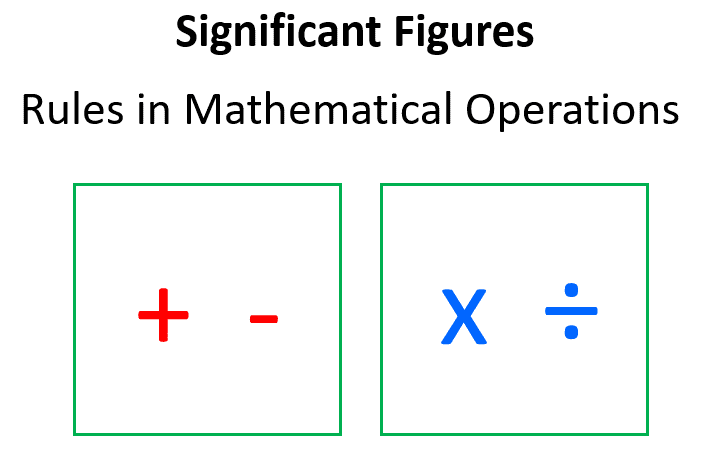
Significant figures play a crucial role in calculations, and it’s essential to consider the number of influential figures in each value. The rules for addition and subtraction differ from those for multiplication and division. Here are some additional rules regarding these operations:
Significant figures: Rules in Mathematical Operations
For addition and subtraction, the result is the same number of decimal places as the value with the most miniature precision. For instance, when adding 128.1 + 1.72 + 0.457, the value with the value with the least decimal places (1) is 128.1. Therefore, the result should have one decimal place: 128.1 + 1.72 + 0.457 = 130.277 = 130.3.
The last significant figure is underlined to indicate its position
The result should have the same number of significant figures as the value with the least significant figures for multiplication and division. For instance, when multiplying 4.321 by 3.14, the value with the fewest significant figures (3) is 3.14. Thus, the result should also be expressed with three crucial figures: 4.321 × 3.14 = 13.56974 = 13.6.
If performing only addition and subtraction or only multiplication and division, you can perform all calculations at once and apply the rules for significant figures to the final result.
However, when performing mixed calculations involving addition/subtraction and multiplication/division, it is vital to consider the number of significant figures at each step. For example, in the calculation 12.13 + 1.72 × 3.4, after the initial step, the intermediate result is 12.13 + 5.848. Note that the result of the multiplication operation has two significant figures and one decimal place. In this case, you should not round the intermediate result but only apply the rules for significant figures to the final result. Therefore, for this example, the final steps of the calculation are 12.13 + 5.848 = 17.978 = 18.0.
Exact values, such as defined numbers and conversion factors, do not affect the accuracy of the calculation and can be treated as if they have an infinite number of significant figures. For example, when using a conversion factor to convert a value in m/s to km/h, the number of significant figures is found by the accuracy of the beginning speed value in m/s. For instance, 15.23 m/s × 3.6 = 54.83 km/h.
FAQs
1. How many significant figures are in the number 100?
2. How many significant figures are in the number 100.00?
3. How many significant figures are in the number 0.01?
4. How many significant figures are in the measurement of 0.00208 grams?
5. How many significant figures are in the measurement of 100.10 inches?
Conclusion
Scientific notation is utilized to simplify extremely large or small numbers. Significant figures provide insight into the precision of a measurement. When performing calculations based on these measurements, it is crucial to consider significant figures carefully. Understanding and applying the following rules is necessary to find the appropriate number of significant figures to retain in the final result.