


Lesson 1 – Physics
Introduction
In today’s era, using various gadgets, machines, vehicles, and more things that are dependent on electricity or energy are all the gifts of Physics. It is a fundamental and extensive subject of science. While it may be challenging compared to other issues, it is also exciting. In this article, we will delve into the definition, history, and branches of physics. So, without wasting much time, let’s begin.
I. Definition
In simple terms, physics is the study of materials and various forms of energy. It is an ancient and vast field of science. The word “physics” originates from Greek, meaning “knowledge of nature”. Essentially, physics aims to analyze and understand the conceptual and analytical phenomena of the universe.
In the broadest sense, it encompasses all aspects of nature on macroscopic and submicroscopic levels. Physics investigates the behavior of objects under the influence of forces and the nature and origin of gravitational, electromagnetic, and nuclear force fields. Its ultimate objective is formulating comprehensive principles to explain and unify these diverse phenomena.
II. History
Physics has a long and rich history that dates back to ancient civilizations, such as the Greeks, Egyptians, and Chinese. These early civilizations made significant contributions to our understanding of the natural world. In the 11th century, scientific knowledge, including physics, was still in its early development stages, and the physical world’s ability was limited.
The modern era of physics began in the 16th and 17th centuries with the groundbreaking work of scientists like Galileo Galilei, Johannes Kepler, and Isaac Newton. Their contributions brought about fundamental changes in our understanding of the material world, mathematics, philosophy, and even society through technological advancements.
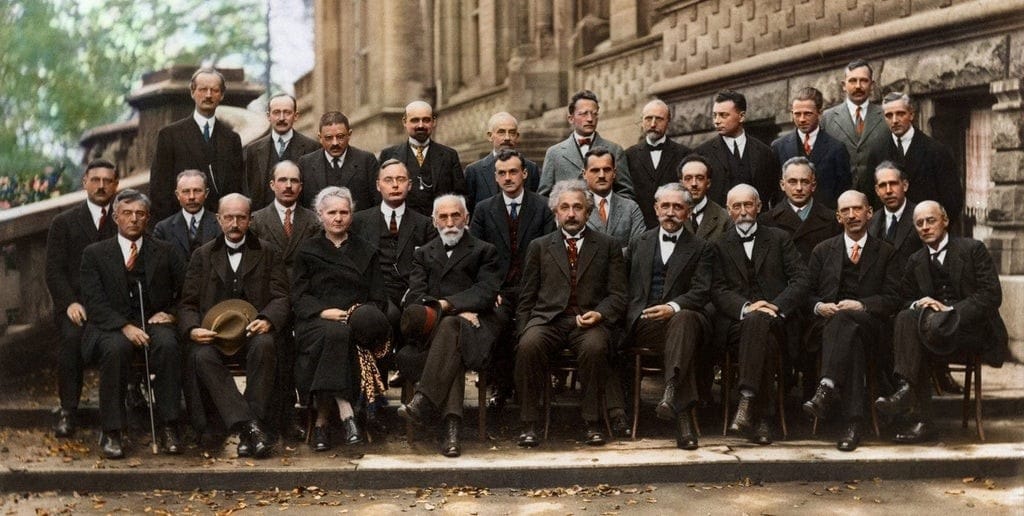
Figure 1: Greatest physicists
The year 1900 marks the beginning of a more modern physics era. In the 19th century, physicists made essential discoveries in electromagnetism, thermodynamics, and atomic theory. Today, physicists continue to make significant advancements in particle physics, cosmology, and quantum computing. These discoveries deepen our understanding of the universe and our place within it.
III. Classic Physics
The branches of physics encompass the various subjects studied within the physics scope. Physics, as a branch of science, focuses on the properties of matter and energy and their interactions. Over time, physicists have divided the subject into different branches, each of which has become a distinct field of study.
1. Mechanics:
Mechanics examines observable phenomena such as the motion of objects, energy transfer between bodies, and interactions among bodies and their surroundings. It can be further divided into two branches: quantum and classical mechanics. Quantum mechanics focuses on studying the behavior and properties of subatomic particles like neutrons, protons, and electrons, while classical mechanics focuses on the laws of motion and forces acting on physical objects.
2. Optics:
Optics plays a significant role in physics, as it concerns the nature of light and its properties. It involves the study of light and its differential behaviors. Light exhibits fascinating characteristics, being both a wave and a particle. It travels as an electromagnetic wave with electric and magnetic field components and does not require a propagating medium.
3. Thermodynamics:
Thermodynamics investigates heat and its relationship with work and energy. It explores how heat transfers from one substance to another. In simple terms, thermodynamics encompasses the interaction between bodies and the universe from an energy perspective. Three fundamental laws govern it:
- First law: energy cannot be created or destroyed; it can only change forms.
- Second law: the irreversible increase in entropy of the universe.
- Third law: the entropy at absolute zero temperature is zero, representing the most ordered state.
4. Sound:
Sound, another important branch of physics, is the study of acoustics. Sound is created by vibrations or mechanical movements in different forms of matter. Acoustics investigates sound frequencies, wavelength alterations in other media, and various intriguing aspects of sound.
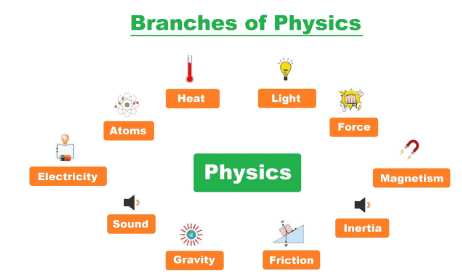
Figure 2: Branches of physics
5. Electromagnetism:
Electromagnetism focuses on manipulating electric fields, electric currents, and magnetic effects. It encompasses two aspects: electricity and magnetism. This branch of physics helps us understand conductors and insulators, the flow of electric current through conductors, and the generation of magnetic fields due to electric currents in wires.
IV. Modern Physics
Modern physics refers to the branch of physics that emerged in the early 20th century and encompasses theories and concepts that go beyond classical physics, which primarily includes Newtonian mechanics and Maxwell’s equations for electromagnetism. The development of modern physics was driven by experimental observations and theoretical advancements that challenged classical ideas and led to the formulation of new theories.
Key components of modern physics include:
Quantum Mechanics:
Special Relativity:
General Relativity:
Quantum Field Theory (QFT):
Standard Model of Particle Physics:
Cosmology:
Modern physics has also significantly advanced our understanding of the large-scale structure and evolution of the universe. The Big Bang theory, for example, is a key component of modern cosmology.
Modern physics has led to numerous technological advancements and has transformed our understanding of the fundamental nature of the universe, from the smallest scales of particles to the largest scales of the cosmos.
Frequently Asked Questions – FAQs
Q1. Define mechanics
Q2. Define optics
Q3. What are the fundamental laws of thermodynamics?
- First law: energy cannot be created or destroyed; it can only change forms.
- Second law: the irreversible increase in entropy of the universe.
- Third law: the entropy at absolute zero temperature is zero, representing the most ordered state.
Q4. What is the aim of physics?
Q5. Define electromagnetism
Conclusion
Physics is an engaging field that has played a pivotal role in developing the devices and technologies integral to our lives today. Its scope encompasses examining various materials and forms of energy, with the ultimate objective of comprehending the phenomena that occur in the universe. Throughout history, physics has undergone a transformative journey, evolving from its early stages to become a driving force behind scientific and technological advancements. The branches of physics encompass a broad spectrum of subjects, including mechanics, optics, thermodynamics, sound, and electromagnetism. These branches collectively contribute to our understanding of the physical world and the fundamental principles that govern it.