


Lesson 5 – Unit Conversion and Dimensional Analysis
Introduction
Unit conversion and dimensional analysis are foundational science, engineering, and mathematics skills. These techniques allow us to move seamlessly between different units of measurement and ensure that our equations and calculations are dimensionally consistent. Understanding unit conversion and dimensional analysis is crucial for solving real-world problems, from calculating travel times to converting recipe measurements.
This lesson aims to help students grasp these concepts by providing a transparent methodology for converting units and analyzing dimensions. By mastering these skills, students will enhance their problem-solving abilities and be better prepared for advanced topics in various scientific and engineering disciplines.
I. The Importance of Unit Conversion and Dimensional Analysis
Unit conversion involves changing a quantity expressed in one unit to another unit without altering its value. This process is essential in fields where different units are used, such as converting kilometers to miles or grams to ounces. Dimensional analysis, on the other hand, is a method that uses the dimensions of physical quantities to check the plausibility of equations and computations. It ensures that mathematical operations involving physical quantities make sense dimensionally.
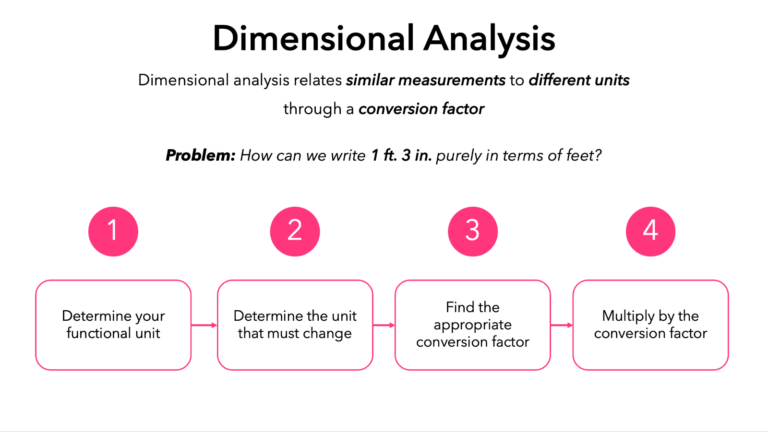
Figure 1: Dimensional Analysis
Learning these skills helps students develop a systematic approach to problem-solving. It teaches them to think critically about the units involved in their calculations and ensures they can confidently handle various practical and theoretical problems.
In engineering and science, dimensional analysis helps describe the relationships between physical quantities based on their fundamental properties like length, mass, time, and electric current. It allows us to convert units from one form to another and ensures that equations representing physical situations are dimensionally consistent.
II. Understanding Dimensional Analysis and Unit Conversion
Dimensional analysis is based on the principle that only quantities with the exact dimensions can be added or subtracted. This principle helps derive relationships between different physical quantities and ensures the consistency of equations.
Physical quantities can be categorized into fundamental and derived quantities:
Fundamental Quantities:
These include mass (M), length (L), time (T), electric current (I), thermodynamic temperature (Θ), amount of substance (N), and luminous intensity (J).
Derived Quantities:
These are obtained by combining fundamental quantities. For example, speed (distance/time) is a derived quantity with dimensions [\((𝐿𝑇)^(−1)\)].
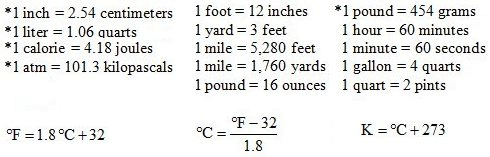
Figure 2: Unit Conversion
For example, speed is a derived quantity expressed as distance divided by time (L/T), where L represents length and T means time.
Unit conversion is often performed using conversion factors, ratios that express the equivalence between different units.
For instance, we use the conversion factor: 1km=1000 meters
To convert 4 km to meters; we multiply by this conversion factor: 4km×1000meters/km=4000meters
1. Single-Step Problems
Single-step unit conversion problems involve one straightforward multiplication or division. For example, converting 25 meters to yards consists of the conversion factor 1 meter = 1.0936 yards:
25 meters×1.0936 yards/meter=27.34 yards
2. Multi-Step Problems
Multi-step problems require multiple conversion factors and careful unit management. For instance, converting 60 miles per hour (mph) to meters per second (m/s) involves two steps:
- Convert miles to meters:
- 1 mile = 1609.34 meters
- 60 miles/hour×1609.34 meters/mile
- Convert hours to seconds:
- 1 hour = 3600 seconds
- Result x \(\frac{1 hour}{3600 seconds}\)
- Combining these steps:
- 60 mph × 1609.34 meters/mile × \(\frac{1 hour}{3600seconds}\) = 26.82 m/s
3. Cancellation of Units
One of the most potent aspects of dimensional analysis is the cancellation of units. This process ensures that only the desired units remain in the final result. For example:
500cm × \(\frac{1meter}{100cm}\) = 5 meters. Here, “cm” cancels out, leaving only “meters.”
III. Extension
1. Applications of Dimensional Analysis
Dimensional analysis has several critical applications:
- Checking Equation Correctness: Ensures that both sides of an equation have the exact dimensions.
- Unit Conversion: Converts quantities from one system of units to another.
- Representing Physical Quantities: Describes the nature of physical quantities.
- Manipulating Dimensions: Allows dimensional expressions to be manipulated algebraically.
- Deriving Formulas: Helps in deriving relationships between physical quantities.
2. Limitations of Dimensional Analysis
While functional, dimensional analysis has limitations:
- Dimensional Constants: It needs to provide information about dimensional constants.
- Function Derivation: Cannot derive trigonometric, exponential, or logarithmic functions.
- Scalar/Vector Identity: This doesn't provide information about whether a quantity is a scalar or vector.
Dimensional analysis is a crucial method in physics and engineering for ensuring the consistency and correctness of equations and unit conversions. It leverages the fundamental dimensions of physical quantities to derive relationships, check equations, and convert units despite certain limitations in handling constants and specific mathematical functions.
IV. FAQs
1. Why is dimensional analysis important?
Dimensional analysis verifies that equations make sense dimensionally, ensuring that calculations involving physical quantities are valid.
2. How do I choose the correct conversion factor?
Identify the units you have and the units you need. Use a conversion factor that relates these units directly.
3. Can dimensional analysis be used for all types of equations?
Dimensional analysis is adequate for equations involving physical quantities. However, it cannot derive trigonometric, exponential, or logarithmic functions.
4. What are common mistakes to avoid?
Common mistakes include not properly canceling units, using incorrect conversion factors, and failing to ensure the final units match the desired outcome.
5. How does dimensional analysis help in real-life applications?
Dimensional analysis is used in engineering to check the plausibility of physical equations, in chemistry for stoichiometric calculations, and in everyday situations like converting units in recipes or travel distances.
Conclusion
Dimensional analysis and unit conversion are essential skills for students in science, engineering, and mathematics. These techniques ensure that equations are dimensionally consistent and that units are correctly converted, leading to accurate and meaningful results. Students can confidently approach various problems by mastering these concepts, from simple unit conv ersions to complex multi-step calculations.
Understanding and applying dimensional analysis helps develop critical thinking and problem-solving skills, which are invaluable in academic and professional settings. This lesson provides a comprehensive overview of these concepts, equipping students with the knowledge and tools they need to succeed in their studies and future careers.