


Lesson 4 – Metric System
Introduction
The metric system, a universal language of measurement, is essential for various activities, from scientific research and medical practice to everyday tasks like cooking and traveling. This system, founded on a decimal basis, simplifies how we measure and convert various quantities, ensuring consistency and precision. The primary goal of this lesson is to provide a comprehensive understanding of the metric system, including its units, conversion methods, and practical applications.
After studying this lesson, you will:
- Understand the basics of the metric system and its historical development.
- Recognize the different metric units for measuring length, mass, area, and capacity.
- Master the methods for converting between different metric units.
- Apply the metric system in real-world contexts.
I. Understanding the Metric System
The metric system is a standardized system of measurement based on the decimal system, with units expressed as powers of ten. This characteristic makes calculations and conversions straightforward and error-free. The metric system, officially known as the International System of Units (SI), was developed during the French Revolution to address the inconsistencies and impracticalities of the existing measurement systems. It was initially conceptualized by John Wilkins and Gabriel Mouton, who proposed standard units based on natural phenomena and decimal multiples.
| The Metric System | |
|---|---|
|
Length |
1 meter = 100 centimeters |
|
1 centimeter = 10 millimeters |
|
|
Distance |
1 kilometer = 1,000 meters |
|
Weight |
1 kilogram = 1,000 grams |
|
Volume |
1 liter = 1,000 mililiters |
|
Temperature |
0°C Cesius = freezing point of water |
|
100°C Cesius = boiling point of water |
|
Figure 1: The metric system
1. Metric System Examples
The metric system encompasses far more than weight, length, and volume. It can also measure time, substance concentration, temperature, electrical current, and light intensity. The following are instances of metric units as used in everyday measures.
- A half marathon is 21.0975 kilometers long.
- The average adult human weighs between 60 and 80 kilograms
- John and Lisa run a kilometer.
- This watermelon weighs 4 kilograms.
- Ashley takes 10 milliliters of tonic.
2. Benefits of the Metric System
The metric system’s success can be attributed to several key benefits:
Simplicity and Consistency:
The decimal-based structure simplifies calculations and reduces potential errors.
Scientific Basis:
Units are derived from natural constants and phenomena, ensuring reproducibility and precision.
Global Standardization:
The metric system's widespread adoption facilitates international trade, scientific collaboration, and communication.
Ease of Learning:
With only seven base units and a logical progression of multiples and submultiples, the metric system is more effortless to learn and use than other systems.
II. History of the Metric System
The metric system is a universal measurement system that has significantly impacted global science, industry, and everyday life. This article explores the historical development of the metric system, key figures involved in its creation, and its adoption worldwide.
1. Early Proposals and Development
John Wilkins
John Wilkins, an English clergyman and a founding member of the Royal Society, was one of the earliest proponents of a universal measurement system. In 1668, he proposed an integrated system of measurement that would be based on natural units derived from phenomena such as the length of a pendulum’s swing. His ideas laid the necessary groundwork for the development of the metric system.
Gabriel Mouton
Gabriel Mouton, a French vicar and scientist, is often credited as the founding father of the metric system. In 1670, Mouton proposed a decimal-based system of measurement. He suggested using the Earth’s dimensions to define a unit of length, which could be divided into smaller units using a decimal system. This proposal significantly influenced later developments in metrication.
Jean Picard
In 1671, a prominent French astronomer, Jean Picard, proposed using the length of a pendulum’s swing as a standard size measure. Based on the consistent nature of a pendulum’s swing, this idea provided a reliable and reproducible unit of measurement.
2. The French Revolution and the Birth of the Metric System
The National Assembly's Call for Standardization
By the late 18th century, the need for a standardized system of weights and measures had become increasingly apparent in France. Amidst the French Revolution, the National Assembly tasked the French Academy of Sciences in 1790 with creating an invariable standard of weights and measurements. The goal was to base this system on natural phenomena and to use a decimal structure for simplicity and ease of use.
The Definition of the Meter
The commission assigned by the academy coined the term “meter” from the Greek word “metron,” meaning “measure.” They defined the meter as one ten-millionth distance between the North Pole and the Equator following the direction of the meridian passing through Paris. This definition provided a scientifically grounded standard. However, the implementation faced challenges. Survey teams tasked with measuring the Earth’s arc encountered suspicion and even imprisonment by local authorities, reflecting the contentious atmosphere of the time.
Official Adoption
Despite initial resistance and political turmoil, the French government officially adopted the metric system on April 7, 1795. This decision marked a significant milestone in measurement history, establishing a universal system that would eventually gain international acceptance.
3. Expansion and Global Adoption
Early Adoption and Resistance
The metric system’s scientific utility quickly became apparent, leading to its adoption by many countries. France made its use compulsory in 1840, and other European nations followed suit. The system’s logical structure and ease of use made it appealing for scientific and industrial applications.
The Treaty of the Meter (1875)
A pivotal moment in the global adoption of the metric system was the signing of the Treaty of the Meter in 1875. This international agreement established the International Bureau of Weights and Measures (BIPM) and created a framework for international cooperation in maintaining measurement standards. The treaty marked the beginning of the metric system’s widespread global acceptance.
The United States and the Metric System
The United States has had a complex relationship with the metric system. In 1866, Congress authorized the use of the metric system, but it was not made mandatory. During the 1970s, there was a strong push towards metrication, but this initiative eventually lost momentum. Despite this, specific industries and scientific communities in the U.S. have adopted the metric system, and there remains a strong possibility of broader adoption in the future due to international pressure and the benefits of standardization.
4. Modern Developments
The International System of Units (SI)
In 1960, the General Conference on Weights and Measures (CGPM) established the International System of Units (SI), which expanded and refined the metric system. SI includes seven base units: meter (length), kilogram (mass), second (time), ampere (electric current), kelvin (temperature), mole (amount of substance), and candela (luminous intensity). This modern version of the metric system is used globally in scientific and industrial contexts.
Redefinition of Units
Recent advancements in science have led to further refinements of the metric system. In 1983, the meter was redefined based on the speed of light, making it more precise. Similarly, in 2019, the kilogram was redefined based on the Planck constant, ensuring greater accuracy and stability in mass measurement.
The history of the metric system is a testament to human ingenuity and the quest for precision and standardization. From the early proposals of John Wilkins and Gabriel Mouton to its adoption during the French Revolution and its evolution into the International System of Units (SI), the metric system has transformed the way we measure and understand the world. Its global adoption underscores its unparalleled utility, ensuring it remains the cornerstone of modern measurement practices.
III. Metric Units
The metric system is grounded in the decimal system, making it logical and easy to use. Each unit is a multiple or a fraction of a base unit, defined by powers of 10. For instance:
Length:
1 meter (m) is the base unit. Smaller units like centimeters (1 m = 100 cm) and millimeters (1 m = 1000 mm) are derived by dividing by 10 or 1000, respectively. Larger units like kilometers (1 km = 1000 m) are obtained by multiplying by 1000.
Mass/Weight
1 gram (g) is the base unit. Kilograms (1 kg = 1000 g) and milligrams (1 g = 1000 mg) are standard units used in everyday life and scientific research.
Area:
square centimeters (sq. cm), square meters (sq. m), square kilometers (sq. km), hectare (ha)
Capacity:
1 liter (l) is the base unit. Smaller units like milliliters (1 l = 1000 ml) and larger units like kiloliters (1 kl = 1000 l) are used to measure various volumes.
Look at the list to comprehend the metric system units utilized in different uses.
| Objective | Metric Units | Shortened as |
|---|---|---|
|
Length |
Millimeters |
mm |
|
Centimeters |
cm |
|
|
Meters |
m |
|
|
Kilometers |
km |
|
|
Mass/Weight |
Milligrams |
mg |
|
Centigrams |
cg |
|
|
Grams |
g |
|
|
Kilograms |
kg |
|
|
Tonne |
t |
|
|
Area |
Square centimeters |
sq. cm |
|
Square meters |
sq. m |
|
|
Square kilometers |
sq. km |
|
|
Hectare (10,000 square meters) |
ha |
|
|
Capacity |
Millimeters |
ml |
|
Centiliters |
cl |
|
|
Liters |
l |
|
|
Kiloliters |
kl |
IV. Metric System Chart
The metric system chart offers equations for converting between different metric units. It allows you to easily convert one unit to another by examining its multiplying factor. For instance, the metric system graphic shows that one metre equals 100 centimetres. To convert 5 metres to centimetres, multiply 5 by 100. Let us examine the metric system graphic shown below:
| Length | Mass/Weight | Capacity |
|---|---|---|
|
1 cm = 10 mm |
1 cg = 10 mg |
1 cl = 10 ml |
|
1 mm = 0.1 cm |
1 mg = 0.1 cg |
1 ml = 0.1 cl |
|
1 m = 100 cm |
1 g = 100 cg |
1 l = 100 cl |
|
1 cm = 0.01 m |
1 cg = 0.01 g |
1 cl = 0.01 l |
|
1 km = 1000 m |
1 g = 1000 mg |
1 l = 1000 ml |
|
1 m = 0.001 km |
1 mg = 0.001 g |
1 ml = 0.001 l |
|
|
1 kg = 1000 g |
1 kl = 1000 l |
|
|
1 g = 0.001 kg |
1 l = 0.001 kl |
|
|
1 tonne = 1000 kg |
|
|
|
1 kg = 0.001 tonne |
|
V. Metric System Conversions
Metric system conversion refers to the process of translating one metric unit into another. Converting between metric units is straightforward due to the decimal nature of the system. Let us discover the conversions in each area one at a time. The metric units of length are discussed in the following paragraph.
For instance, if Alice measures the height of a pillar as 24 metres but wants to know the value in kilometres, she can convert m to km using the proper conversion formula.
1. Length
Length can be measured in a variety of units, including inches, centimetres, feet, and kilometres. However, the metric system’s length measuring units are millimetres, centimetres, metres, and kilometres. The length in the metric system can be measured with a ruler or a measuring tape with centimetre units. The metric system chart for length conversion is shown below to help you understand the relationship between different units.
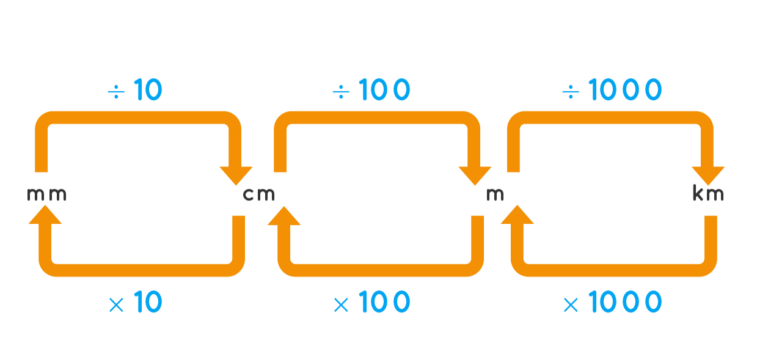
Figure 2: Metric conversion of Length
It demonstrates how to convert millimetres (mm) to centimetres (cm) by dividing the given number by ten, centimetres (cm) to metres (m) by dividing the given value by one hundred, and so on. Simply follow the direction of the arrows and look for the multiplication factor in each example. When moving from bigger to smaller units (for example, km to m, m to cm, and so on), we multiply the value by an appropriate power of ten. When transitioning from smaller to bigger units (for example, mm to cm, cm to m, and m to km), divide the value by an appropriate power of ten.
- To convert meters to centimeters, multiply by 100.
- To convert centimeters to millimeters, multiply by 10.
- To convert kilometers to meters, multiply by 1000.
2. Mass/Weight
The kilogramme is the standard unit for measuring weight. The beam balance, or weighing scale, is the traditional equipment for measuring weight.
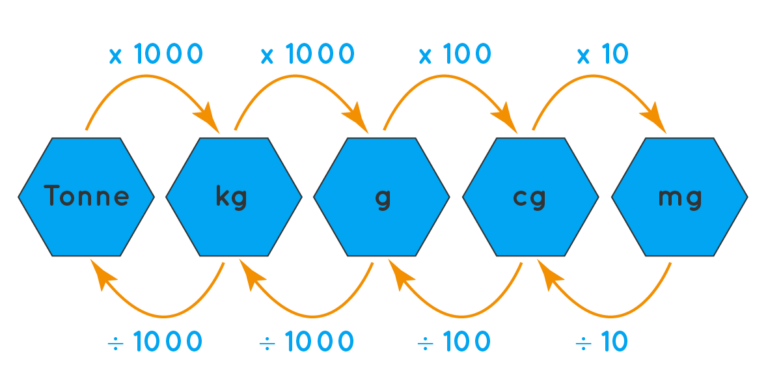
Figure 3: Metric conversion of Weight
- To convert kilograms to grams, multiply by 1000.
- To convert grams to mi lligrams, multiply by 1000.
3. Capacity
The term capacity refers to the amount of space or volume that a thing takes up. Litres are the common unit for measuring capacity. The measuring cup is the typical tool for measuring capacity.
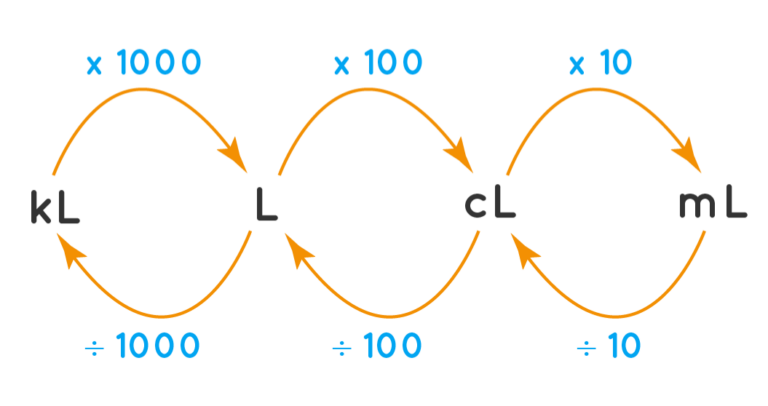
Figure 4: Metric conversion of Capacity
- To convert liters to milliliters, multiply by 1000.
- To convert milliliters to liters, divide by 1000.
4. Examples of Conversions
Length conversions:
If Alice measures a pillar as 24 meters, to convert it to kilometers, divide by 1000:24 m÷1000=0.024 km, 24m÷1000=0.024km
Weight conversions:
If a loaf o f bread weighs 1 kilogram, to convert it to grams, multiply by 1000:1 kg×1000=1000 g, 1kg×1000=1000g
Capacity conversions:
If a container holds 500 milliliters of oil, to convert it to liters, divide by 1000:500 ml÷1000=0.5, l500ml÷1000=0.5l
VI. Extension
1. Metric System vs Imperial System
The metric system is widely used and easier to understand due to its decimal basis. In contrast, the imperial system, used in countries like the US and Myanmar, includes units like inches, feet, and pounds without a consistent pattern.
Comparison:
| Metric System | Imperial System |
|---|---|
|
Based on decimal units (powers of 10) |
No specific pattern |
|
Units: centimeters, meters, grams, liters, etc. |
Units: inches, feet, pounds, miles, etc. |
2. Essential Notes on Metric System
- The standard unit for measuring length is the meter.
- The standard unit for measuring weight is the kilogram.
- The standard unit for measuring capacity is the liter.
- Time is measured using hours, minutes, and seconds.
Understanding the metric system and its conversions is essential for accuracy in measurement and everyday calculations.
VII. FAQs About the Metric System
1. Why is the metric system preferred over other systems?
The metric system is preferred because it is based on the decimal system, making calculations and conversions simpler and more consistent than the imperial system.
2. Which countries do not use the metric system?
The United States, Myanmar, and Liberia primarily use the imperial system. However, metric units are also commonly used in scientific and medical fields within these countries.
3. How did the metric system originate?
The metric system originated during the French Revolution to standardize measurements for trade and science. It was developed by John Wilkins and Gabriel Mouton, who based it on natural phenomena and decimal multiples.
4. What are some everyday examples of metric system usage?
Common examples include measuring distances in kilometers, weighing produce in kilograms, and buying beverages in liters.
5. How do you convert metric units?
Conversion between metric units involves multiplying or dividing by powers of 10. For example, to convert meters to centimeters, multiply by 100; to convert grams to kilograms, divide by 1000.
Conclusion
The metric system is an efficient and universal system of measurement, widely adopted for its simplicity and consistency. It is based on the decimal system, facilitating easy conversion between units. This lesson covered the basic concepts of the metric system, its historical background, various metric units, and practical conversion methods. By mastering these elements, you can confidently apply the metric system in everyday life and various professional fields.
Understanding and using the metric system enhances precision in measurement and communication, making it an indispensable tool in our globalized world.