


Lesson 3 – Experimental Design in Science
Introduction
Experimental design is a foundational component of scientific research, providing a structured approach to investigating hypotheses, collecting data, and drawing reliable conclusions. Through careful planning and execution, scientists can isolate variables, control conditions, and ensure the validity and reproducibility of their results. This lesson delves into the principles of experimental design, outlining its definition, process, and essential steps. By mastering these principles, we will equip students to conduct rigorous scientific investigations and contribute meaningful insights to their fields of study. This lesson aims to understand the components of experimental design, recognize the characteristics of a good experiment, and apply these principles to real-world examples.
I. Definition of Experimental Design
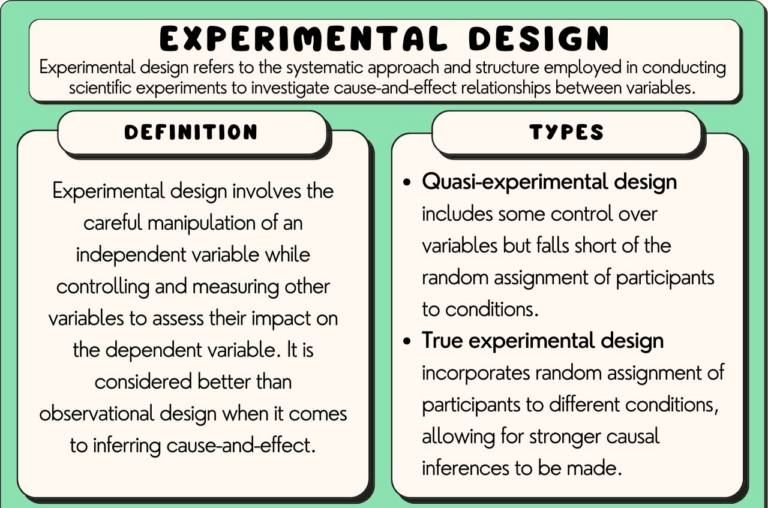
Figure 1: Experimental design
The independent and dependent variables are significantly linked to one another. An experiment involves manipulating an independent variable. The experimenter causes the independent variable to change. As the independent variable changes, so does the dependent variable.
The experimenter must establish variables, assign volunteers, and assess the dependent variable.
Experimental design is a method of testing a hypothesis using a series of actions. An experimental design aims to create controlled circumstances for an experiment that restrict exposure to outside disturbance. An experimental design leads to a conclusion based on your hypothesis.
The results of experimental research may provide supportive evidence for scientific law and theory. Scientific law and theory are healthy and supported by evidence gathered through experimental design. However, neither a theory nor a law can become the other. The differences between the two are:
- Laws describe "what" happens; theories explain "why" and "how."
- Laws predict outcomes; theories provide explanations.
- Laws are based on repeated observations; theories are developed through extensive research.
- Laws have a narrower focus; theories have a broader scope.
- Laws remain constant; theories can be refined with new evidence.
Some various experimental designs for study. They are:
- Pre-experimental research design.
- True-experimental research design.
- Quasi-experimental Research Design
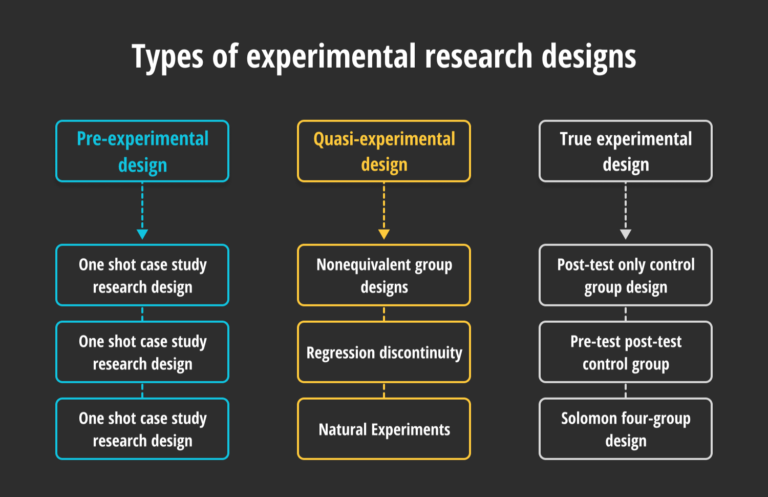
Figure 2: Types of Experimental design
Experimental design is the systematic process of planning and conducting experiments to test hypotheses. This process involves selecting variables, determining how they will be measured, and establishing a procedure for experimenting. The goal is to provide a controlled environment in which independent variables’ effect on dependent variables may be examined and researched.
II. The experimental design process
The experimental design is a series of techniques intended to test a hypothesis. The procedure consists of five steps: defining variables, developing a hypothesis, designing an experiment, assigning subjects, and measuring the dependent variable.
One must have a testable concept (hypothesis) to begin the experimental design process. To generate a testable idea, ask questions. The questions asked lead to deciding what information one wishes to obtain from their experiment.
To experiment, one must have a method for measuring the results. The measurements must be accurate and precise. Once the data is collected, it must be analyzed. The creation of graphs and data tables from the acquired data aids in the analytical process. The analysis focuses on what the data says and how the information will be used.
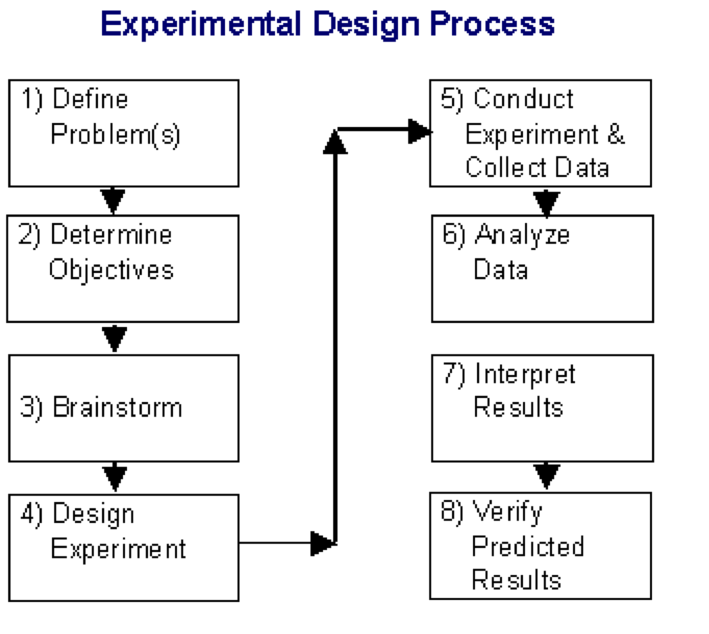
Figure 3: Experimental design process
1. Define Variables
The first step in the experimental design process is clearly defining the variables involved in the experiment. The variables are the experimental components that operate as factors. There are three types of variables:
Independent Variable:
The variable which the scientist affects to find out the impact it has.
Dependent Variable:
The variable measured to see if it changes due to manipulations to the independent variable.
Control Variables:
These variables are kept constant to ensure they do not influence the experiment's outcome. Controlling these variables helps isolate the effect of the independent variable on the dependent variable.
For example, to establish the variables for an experiment, the experimenter must consider the subject and what they intend to test. For this example, the experiment is about plants, and the light color will produce the highest plant growth. The independent variable exposes plants to red, green, yellow, and blue light. The dependent variable is plant growth in response to each light color.
2. Formulate a Hypothesis
Once the variables are defined, the next step is to formulate a hypothesis. A hypothesis is a testable prediction regarding the connection between the independent and dependent variables, and it is also an educated guess about the experiment’s outcome before its execution. The goal is to prove or deny the hypothesis after the experiment. When developing a hypothesis, a statement should be written.
It is often stated in an “if…then…” format, specifying what the researcher expects to happen when the independent variable is manipulated. For example, “If plants are exposed to blue light, then they will grow taller than plants exposed to red light.”
3. Design an Experiment
With a clear hypothesis, the researcher can design the experiment. This involves developing a detailed plan that outlines how the experiment will be conducted, including:
Procedures for Manipulating the Independent Variable:
How the independent variable will be changed or controlled during the experiment.
Measurement Methods for the Dependent Variable:
The tools and techniques that will be used to measure the dependent variable accurately and precisely.
Experimental Protocols:
Step-by-step instructions are provided to ensure the consistency and repeatability of the experiment.
4. Assign Subjects
In this step, subjects or samples are assigned to different experimental conditions. This can involve:
Randomization:
Assigning subjects to groups randomly to prevent selection bias and ensure that each group is comparable.
Blocking:
Grouping subjects based on specific characteristics before random assignment to control for variability within these groups.
Matching:
Pair subjects with specific traits and then split each pair into different treatment groups to reduce variability.
5. Measure the Dependent Variable
The final step is to conduct the experiment and measure the dependent variable. Accurate and precise data collection is essential. This step includes:
Data Collection:
Using reliable measurement tools and techniques to gather data on the dependent variable.
Data Analysis:
Analyze the collected data to determine whether the hypothesis is supported. This often involves creating graphs and data tables, performing statistical analyses, and interpreting the results.
Example of the Five Steps in Practice
Step 1
Define Variables
- Independent Variable: Type of light (blue, red, white).
- Dependent Variable: Plant height.
- Control Variables: Soil type, water amount, temperature.
Step 2
Formulate a Hypothesis
"If plants are exposed to blue light, they will grow taller than plants exposed to red light."
Step 3
Design an Experiment
- Procedures: Expose plants to different light types for eight weeks.
- Measurement Methods: Measure plant height weekly with a ruler.
- Protocols: Ensure all plants receive the same amount of water and are kept at the same temperature.
Step 4
Assign Subjects
Randomly assign 60 identical plants to three groups (20 per light type).
Step 5
Measure the Dependent Variable
- Collect data on plant height weekly.
- Analyze the data by creating graphs to compare the growth under different light conditions and perform statistical tests to determine if the differences are significant.
By following these five steps, researchers can ensure their experiments are well-designed, producing reliable and valid results that contribute to scientific knowledge.
III. How to Write an Experimental Design in Science
Writing a clear and detailed experimental design is crucial for the success of any scientific experiment. It ensures that the experiment can be replicated accurately, essential for validating results. This guide will help you understand the critical components of an experimental design and provide practical tips for writing one effectively.
An experimental design is a detailed plan outlining the experiment’s steps. It includes every action in the order it should be performed and is divided into two main sections: Materials and Methods.
1. How to Write a Strong Materials Section
The materials section should list all items used in the experiment, specifying quantities, sizes, and any other relevant details. Think of it as a recipe where each ingredient is clearly described to ensure the experiment can be replicated precisely.
Tips for Writing the Materials Section
- Be Specific: Provide exact quantities and sizes for each material.
- Be Thorough: Include every item necessary for the experiment.
- Be Clear: Ensure that the list is easy to understand and follow.
Examples of Materials Listings
| Accomplished | Developing | Not Met |
|---|---|---|
|
500 ml of de-ionized water |
De-ionized water |
Water |
|
1 stopwatch with 0.1 sec accuracy |
1 stopwatch |
Watch |
|
1 AA alkaline battery |
AA alkaline battery |
Battery |
Grading Rubric for Materials
- Accomplished: Lists materials with specific amounts and sizes.
- Developing: Lists materials without specific details.
- Not Met: Fails to list necessary materials.
2. How to Write a Strong Methods Section
The methods section should describe exactly how you conducted your experiment. It should be detailed enough to allow someone else to replicate it accurately, including specific measurements, times, and conditions.
Tips for Writing the Methods Section
- Detail and Precision: Include specific measurements, times, and conditions.
- Relevance: Focus on details that are critical to the experiment's success.
- Rationale: Explain why each step is performed to demonstrate your understanding and critical thinking.
Example of an Accomplished Methods Section
| Preparation | Procedure | Rationale | Developing | Not Met |
|---|---|---|---|---|
|
Number each battery to distinguish them. |
Place each battery in a temperature-controlled environment set to 25°C to standardize conditions. |
Numbering the batteries helps track individual measurements accurately. |
Number each battery. |
Measure battery voltage. |
|
Measure each battery’s voltage using a voltmeter. Ensure the voltmeter is calibrated to 0.01 volts for accuracy. |
Insert each battery into a designated test circuit designed to measure discharge rates. |
Using a temperature-controlled environment eliminates temperature as a variable, ensuring consistent results. |
Measure the voltage of each battery using a voltmeter. |
Place in a controlled environment. |
|
|
Record the initial voltage and measure the voltage every hour for 24 hours using the voltmeter. |
Measuring voltage regularly provides data on the discharge rate over time, allowing for battery performance analysis. |
Place the batteries in a controlled environment. |
Measure periodically. |
|
|
Cap the test tube immediately after adding a solute to the solvent to prevent evaporation, which could affect concentration. |
Capping the test tube prevents evaporation, ensuring the solute concentration remains constant, which is crucial for accurate results. |
Measure the voltage periodically. |
|
Grading Rubric for Methods
- Accomplished: Detailed explanation with specific measurements and rationale, ensuring reproducibility.
- Developing: General explanation of the experimental process.
- Not Met: No explanation of the experimental process.
IV. What Makes a Good Experiment?
Several essential qualities characterize a good experimentalizes:
Reliability:
The experiment produces consistent results when repeated under the same conditions.
Validity:
The experiment accurately measures what it is intended to measure.
Control:
Extraneous variables are controlled to ensure that results are due to the manipulation of the independent variable.
Replication:
The experiment can be replicated by other researchers, confirming the reliability and accuracy of the findings.
Randomization:
To minimize bias, subjects or samples are randomly assigned to different groups.
V. Examples of Experimental Investigation
1. Investigating Plant Growth
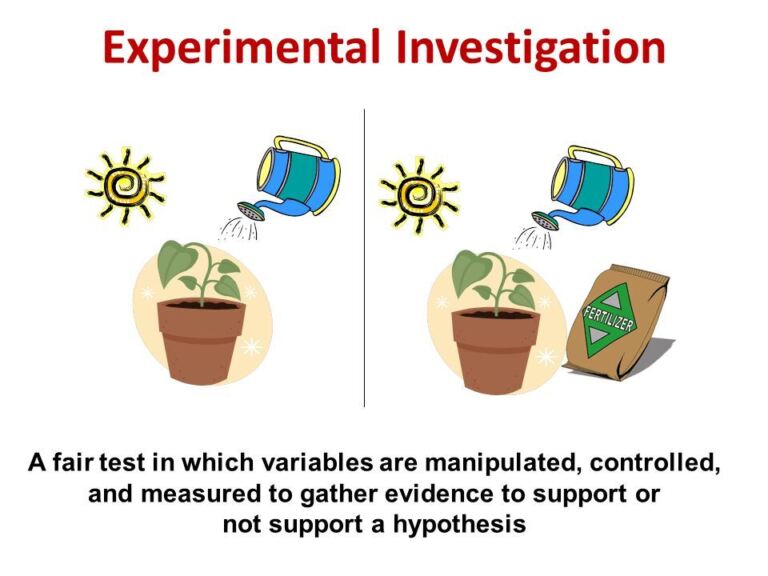
Figure 4: Investigating plant growth
- Hypothesis: Plants grow faster when exposed to blue light than red light.
- Independent Variable: Light color (blue or red).
- Dependent Variable: Plant growth (measured in height).
- Control Variables: Soil type, water amount, plant species.
- Procedure: Two groups of identical plants are grown under blue and red light. Growth is measured over several weeks.
2. Testing a New Drug
- Hypothesis: A new drug reduces blood pressure more effectively than a placebo.
- Independent Variable: Type of treatment (new drug or placebo).
- Dependent Variable: Blood pressure levels.
- Control Variables: Patient age, diet, exercise regimen.
- Procedure: Patients are randomly assigned to receive either the new drug or a placebo. Blood pressure is monitored over a specified period.
VI. FAQs
1. Can a scientific theory become a scientific law?
No, a scientific theory cannot become a scientific law. They serve different purposes: laws describe patterns observed in nature, while theories explain the underlying reasons for those patterns.
2. Why is experimental design important in scientific research?
Experimental design is crucial because it ensures that experiments are structured to yield valid, reliable, and unbiased results. This allows researchers to draw meaningful conclusions and build robust scientific knowledge.
3. How do control variables improve the validity of an experiment?
Control variables improve validity by ensuring that any changes in the dependent variable are solely due to the manipulation of the independent variable. This helps isolate the effect of the independent variable, leading to more accurate and reliable results.
4. What is the role of replication in experimental design?
Replication is essential for verifying the reliability of experimental results. By repeating experiments and obtaining consistent results, researchers can confirm that their findings are not due to chance or specific to a particular set of conditions.
Conclusion
Experimental design is vital to scientific research, enabling scientists to systematically test hypotheses, gather data, and draw reliable conclusions. Researchers can ensure their investigations are robust and meaningful by following a structured process that includes formulating a hypothesis, identifying variables, designing and conducting the experiment, analyzing data, and drawing conclusions. Understanding the principles of experimental design allows students to engage in scientific inquiry with rigor and confidence. Additionally, distinguishing between scientific laws and theories helps clarify their roles in explaining and describing natural phenomena, highlighting the importance of advancing scientific knowledge.