


Lesson 2 – The Scientific Method
Introduction
The scientific method is a systematic approach to investigating natural phenomena, acquiring new knowledge, or correcting and integrating previous knowledge. It is fundamental to scientific inquiry and ensures that findings are based on objective and reproducible evidence. Understanding the scientific method is crucial for students, as it equips them with the skills to think critically, conduct experiments, and analyze data in a structured way. This lesson will introduce the scientific method, outline its six steps, and provide examples of its application in producing scientific theories. Additionally, we will address common questions students may have about this method.
I. What is the Scientific Method?
The scientific method is a logical sequence of steps that scientists use to develop an understanding of the natural world. It involves making observations, forming hypotheses, conducting experiments, analyzing results, and drawing conclusions. This method allows scientists to create reliable and consistent explanations for the phenomena they study.
- Question: a difficulty the scientist wants to solve.
- Background: information that is already accessible from past trials that can help inform the scientist about the subject
- Hypothesis: a hypothesis that can be verified through experimentation
- Experiment: an experiment in science supplying empirical proof for a specific hypothesis
- Empirical Data: data that is verified by observation and/or experience
- Conclusion: a response to the research question offered by the facts, which may support or deny the hypothesis.
II. Who Invented The Scientific Method?
The scientific method, as we know it today, is the result of centuries of development and contributions from many different thinkers and civilizations. No single person can be credited with “inventing” the scientific method; rather, it evolved over time. Here is a brief overview of key figures who played crucial roles in the development of the scientific method:
1. Ancient Roots
Aristotle (384-322 BCE):
Ancient Greek philosopher Aristotle made significant contributions to early scientific thought. He emphasized empirical observation and systematic collection of data, laying groundwork for future scientific methods.
Ibn al-Haytham (Alhazen) (965-1040 CE):
A Persian scientist and philosopher, Ibn al-Haytham is often considered one of the earliest proponents of the experimental scientific method. His work in optics involved systematic experimentation and the use of hypotheses, making him a pivotal figure in the history of science.
2. The Renaissance and Early Modern Period
Roger Bacon (1219/20-1292 CE):
An English philosopher and Franciscan friar, Roger Bacon advocated for empirical methods and the study of nature through direct observation and experimentation. He emphasized the importance of mathematics in scientific investigation.
Francis Bacon (1561-1626 CE):
Often regarded as one of the fathers of the modern scientific method, Francis Bacon was an English philosopher and statesman who developed a method known as the "Baconian method." His approach emphasized inductive reasoning, where specific observations lead to general conclusions. He advocated for systematic experimentation and the use of empirical evidence to form knowledge.
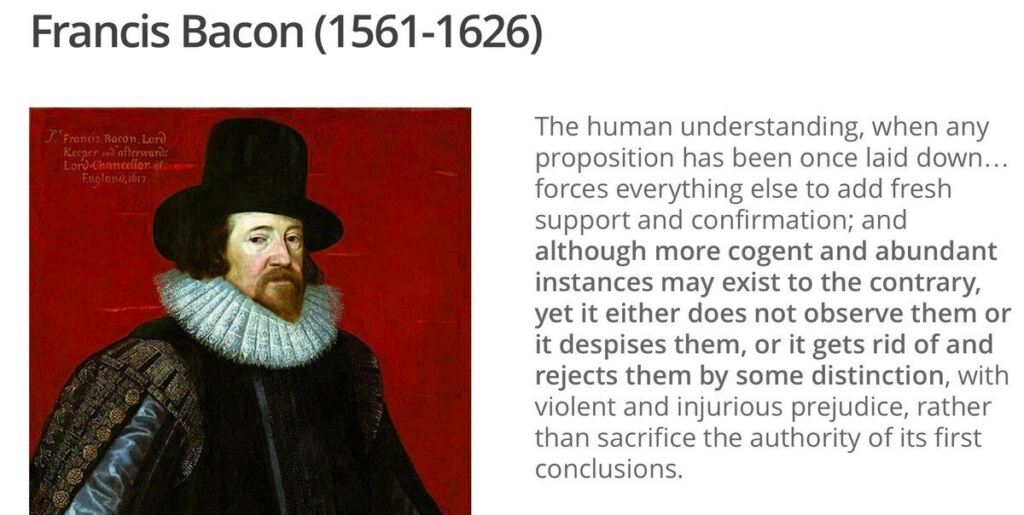
Figure 1: The Scientific Method Steps
3. The Scientific Revolution
Galileo Galilei (1564-1642 CE):
An Italian astronomer, physicist, and engineer, Galileo's work exemplified the scientific method in practice. He conducted experiments to test his hypotheses about motion and mechanics, making significant contributions to the fields of astronomy and physics.
René Descartes (1596-1650 CE):
A French philosopher and mathematician, Descartes contributed to the scientific method through his emphasis on deductive reasoning. His work in developing a methodological skepticism—questioning everything that could be doubted—laid the groundwork for systematic scientific inquiry.
4. Formalization and Modern Development
Isaac Newton (1642-1727 CE):
An English mathematician, physicist, and astronomer, Newton's work in formulating the laws of motion and universal gravitation demonstrated the application of the scientific method. His book "Principia Mathematica" laid the foundation for classical mechanics.
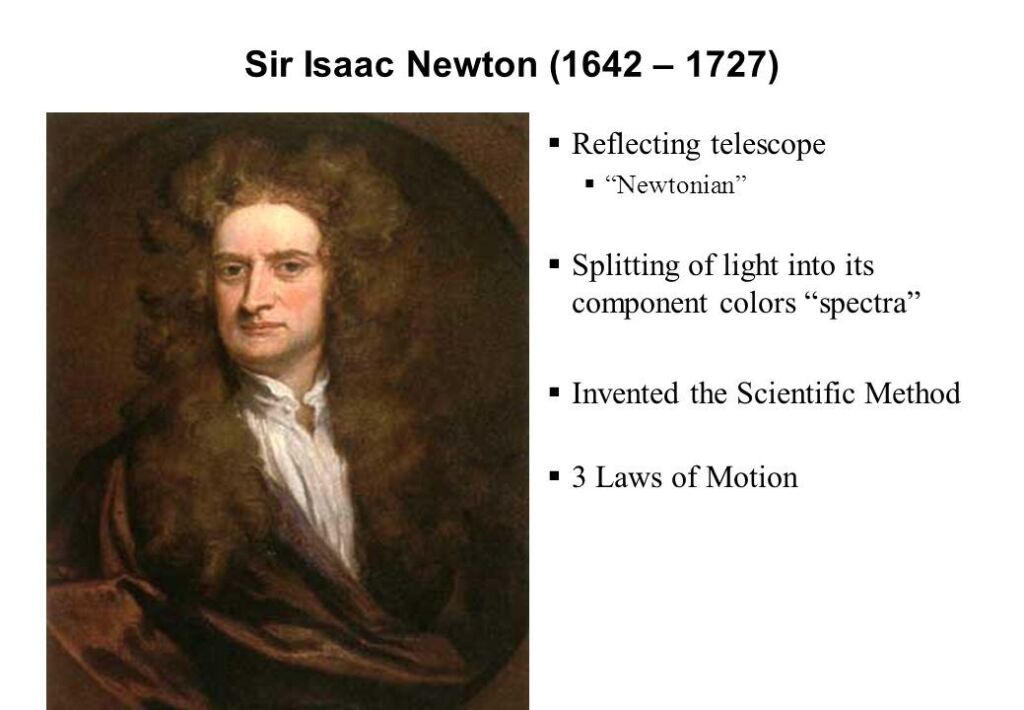
Figure 2: Sir Isaac Newton (1642 -1727)
Karl Popper (1902-1994 CE):
In the 20th century, philosopher of science Karl Popper further refined the scientific method. He emphasized the importance of falsifiability in scientific theories, arguing that for a hypothesis to be scientific, it must be testable and potentially refutable.
III. The Six Steps of the Scientific Method
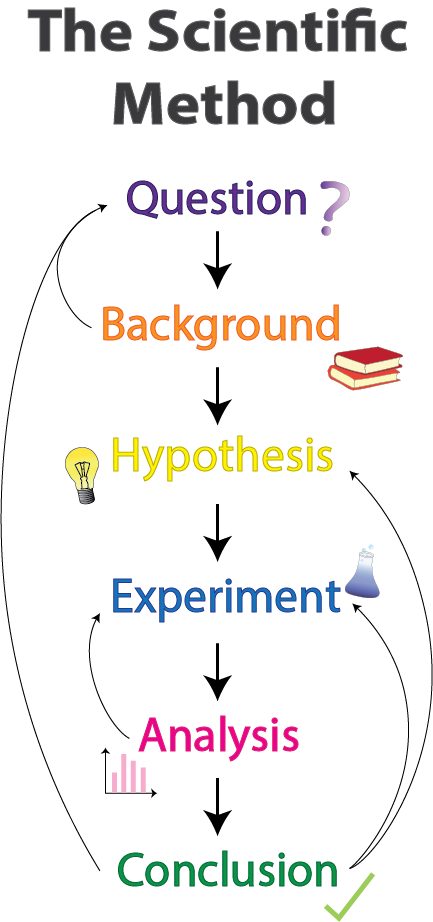
Figure 3: The Scientific Method
1. Observation
Observation is the process of gathering information through the senses or scientific tools. It involves noting and recording natural phenomena, patterns, or behaviors.
Observations are the foundation of scientific inquiry. They prompt questions and curiosity about how and why things happen. Observations can be qualitative (descriptive) or quantitative (measurable). Scientists use various instruments, such as microscopes, telescopes, and sensors, to enhance their observations and gather detailed data. Accurate and precise observations are critical, as they form the basis for formulating hypotheses and designing experiments. Furthermore, repeated observations help ensure consistency and reliability in the data collected.
Example: A botanist observes that plants in sunlight grow faster than plants in the shade.
2. Question
Based on observations, scientists ask specific, focused questions that aim to explain the observed phenomena.
The question step involves narrowing down a broad observation into a specific query that can be tested. This step is essential for directing the research and framing the scope of the investigation. Good scientific questions are clear, concise, and testable. They often begin with "how," "why," or "what" and should lead to hypotheses that can be experimentally verified. Developing a precise question ensures that the research is focused and manageable, allowing scientists to design experiments that directly address the core issue.
Example: Why do plants grow faster in sunlight than in the shade?
3. Hypothesis
A hypothesis is a tentative explanation or prediction based on prior knowledge and observations. It provides a basis for experimentation.
Formulating a hypothesis involves combining existing knowledge with new observations to make an educated guess about the outcome of an investigation. A strong hypothesis is specific and testable, meaning it makes clear predictions that can be confirmed or refuted through experimentation. Hypotheses are often framed in an "if...then..." format, specifying the expected relationship between variables. Crafting a well-defined hypothesis is crucial because it guides the design of experiments and the interpretation of results. A hypothesis should also be falsifiable, meaning there must be a possible outcome that would demonstrate it to be false.
Example: Plants grow faster in sunlight because they use light for photosynthesis, which is essential for their growth.
4. Experiment
Experimentation involves designing and conducting controlled tests to examine the validity of the hypothesis. This step includes identifying variables, establishing procedures, and collecting data.
The experiment step is the practical application of the hypothesis. It involves manipulating one or more independent variables to observe the effect on a dependent variable while controlling other factors that might influence the results. Designing a robust experiment requires careful planning to ensure that the data collected will be reliable and valid. This includes selecting appropriate methods, tools, and techniques, as well as considering factors like sample size and replication. Control groups and randomization are often used to minimize bias and confounding variables. Detailed documentation of experimental procedures and conditions is vital for reproducibility and transparency.
Example: The botanist sets up two groups of identical plants, one group placed in sunlight and the other in the shade. All other conditions (soil, water, etc.) are kept constant. The growth of the plants is measured over several weeks.
5. Analysis
Analysis involves interpreting the data collected during the experiment to determine whether it supports or refutes the hypothesis.
Analyzing data is a critical step that requires statistical and logical reasoning to interpret the results of the experiment. This process involves organizing the data, performing statistical tests, and using graphs or charts to visualize trends and patterns. Scientists look for correlations, differences, and anomalies in the data to draw meaningful conclusions. Proper analysis helps identify whether the observed effects are statistically significant or if they could have occurred by chance. This step also involves critically assessing the methodology and considering potential sources of error or bias. A thorough analysis ensures that the conclusions drawn are based on solid evidence.
Example: The botanist measures the height, leaf size, and overall health of the plants in both groups and compares the results to see if there is a significant difference between the plants grown in sunlight and those grown in the shade.
6. Conclusion
The conclusion is drawn based on the analysis. It determines whether the hypothesis was supported or refuted and suggests implications for further research.
Drawing a conclusion involves synthesizing the findings of the analysis to answer the original question. If the hypothesis is supported, the conclusion may reinforce existing theories or contribute new insights. If the hypothesis is refuted, scientists must reconsider their assumptions and possibly formulate new hypotheses. Conclusions should be clear, concise, and directly related to the hypothesis and research question. This step often leads to new questions and further investigations, demonstrating the iterative nature of scientific inquiry. Reporting the conclusion includes discussing the significance of the findings, the limitations of the study, and recommendations for future research.
Example: The botanist concludes that plants indeed grow faster and healthier in sunlight, supporting the hypothesis that light is crucial for photosynthesis and plant growth.
IV. Examples of the Scientific Method in Action
The scientific method has been used to produce many theories and advancements in various fields. Here are a few notable examples:
1. Theory of Gravity
- Observation: Objects fall to the ground when dropped.
- Question: Why do objects fall to the ground?
- Hypothesis: There is a force pulling objects towards the Earth.
- Experiment: Measuring the rate of falling objects and comparing results.
- Analysis: Analyze the data to determine a consistent force.
- Conclusion: The development of the theory of gravity, was later refined by Newton and Einstein.
2. Germ Theory of Disease
- Observation: People who come into contact with sick individuals often become ill.
- Question: What causes illness to spread?
- Hypothesis: Microorganisms cause disease.
- Experiment: Conducting experiments to show the presence of bacteria in diseased tissue.
- Analysis: Analyzing the presence and behavior of microorganisms in different conditions.
- Conclusion: The establishment of germ theory, revolutionizing medicine and hygiene practices.
V. FAQs
1. Why is the scientific method important?
The scientific method is important because it provides a structured and objective way to investigate questions and problems, leading to reliable and repeatable results. It reduces bias and ensures that conclusions are based on evidence.
2. Can the scientific method be used in everyday life?
Yes, the scientific method can be applied to everyday problem-solving. For example, if your car won’t start, you might observe the symptoms, ask why it’s not starting, form a hypothesis (e.g., the battery is dead), test this hypothesis by checking the battery, analyze the results, and conclude whether your hypothesis was correct.
3. What happens if a hypothesis is not supported by the experimental data?
If a hypothesis is not supported, it is either revised or rejected. Scientists then form a new hypothesis and test it through further experimentation. This iterative process helps refine scientific understanding.
4. How do scientists ensure their experiments are fair and unbiased?
Scientists use control groups, randomization, and blind or double-blind studies to reduce bias. They also replicate experiments and peer review their findings to ensure reliability and accuracy.
5. Can a hypothesis become a theory?
Yes, a hypothesis can become a theory if it is repeatedly tested and consistently supported by evidence over time. Theories provide comprehensive explanations for phenomena and are widely accepted within the scientific community.
Conclusion
The scientific method is a cornerstone of scientific inquiry, providing a structured framework for investigating questions and solving problems. By following its six steps—observation, question, hypothesis, experiment, analysis, and conclusion—scientists can develop reliable, evidence-based explanations for natural phenomena. Understanding and applying the scientific method enables students to think critically, conduct rigorous experiments, and contribute to the advancement of scientific knowledge. This systematic approach not only fosters scientific literacy but also cultivates a mindset of curiosity and problem-solving that is valuable in everyday life.