


Lesson 2 – Deductive and Inductive Reasoning
Introduction
Welcome to our lesson on deductive and inductive reasoning! In this lesson, we will explore two fundamental forms of reasoning: deductive and inductive. Deductive reasoning involves using logical connections to reach specific conclusions, while inductive reasoning involves making reasonable inferences based on observations or patterns. By the end of this lesson, you will have a strong grasp of these reasoning methods and their practical applications. Let’s get started!
I. Definition
1. Definition of reasoning
Reasoning refers to the mental process of making logical connections between different pieces of information or ideas to reach a conclusion or make a judgment. It involves using evidence, facts, and logical thinking to support or refute claims and make informed decisions.
2. Importance of Reasoning in Everyday Life:
Reasoning plays a vital role in our everyday lives, enabling us to navigate through various situations and make informed choices. Here are some key reasons why reasoning is important:
Decision Making:
Reasoning helps us analyze available information, weigh different options, and make rational decisions. It allows us to consider various factors, evaluate the pros and cons, and choose the most suitable course of action.
Problem Solving:
Reasoning provides a structured approach to problem-solving. It helps us break down complex problems into smaller, manageable parts, identify patterns and connections, and find logical solutions.
Critical Thinking:
Reasoning fosters critical thinking skills by encouraging us to question assumptions, examine evidence, and evaluate arguments. It helps us distinguish between valid and invalid claims, spot logical fallacies, and develop a more discerning mindset
Effective Communication:
Reasoning enhances our ability to express our thoughts and ideas coherently. It enables us to construct logical arguments, present evidence, and engage in meaningful discussions, thereby improving our communication and persuasive skills.
Avoiding Bias and Fallacies:
Reasoning helps us recognize and avoid common cognitive biases and logical fallacies that can cloud our judgment. It promotes objective thinking and encourages us to consider alternative perspectives and evidence.
Understanding and Evaluating Information:
In today's information-rich world, reasoning enables us to critically evaluate the vast amount of information we encounter. It allows us to separate reliable sources from misinformation, identify logical inconsistencies, and make informed judgments
Academic and Professional Success:
Reasoning skills are highly valued in academic settings and professional environments. They are essential for tasks such as analyzing data, conducting research, making presentations, and engaging in logical reasoning-based disciplines like mathematics, science, law, and philosophy.
By developing strong reasoning skills, individuals can become more analytical, logical, and effective in their personal and professional lives. It empowers us to think critically, solve problems, and make informed decisions based on sound evidence and logical thinking.
II. Deductive Reasoning
1. Definition of deductive reasoning:
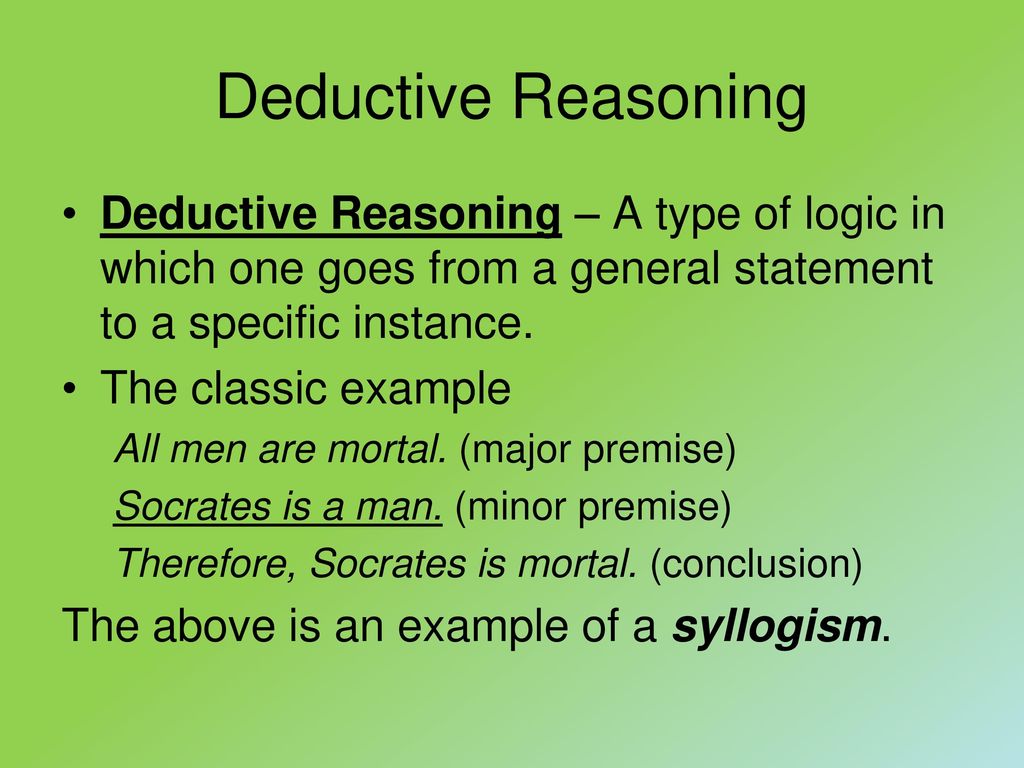
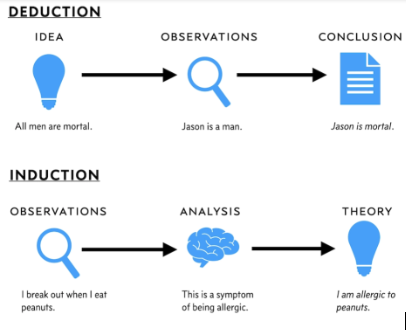
Deductive reasoning is a logical process in which conclusions are derived from general principles or premises. It involves moving from general statements, known as premises, to specific conclusions based on the logical connections between them.
Deductive reasoning is a valuable and widely used form of logical thinking for several reasons:
a. Guaranteed Conclusions:
Deductive reasoning provides a way to reach conclusions that are guaranteed to be true if the premises (initial statements or assumptions) are true. This makes it a powerful tool for establishing certain truths.
b. Clarity and Precision:
Deductive reasoning forces you to be clear and precise in your thinking. It involves a step-by-step process of drawing conclusions from premises, which helps to identify any errors or fallacies in the argument.
c. Problem Solving:
Deductive reasoning is often used in problem-solving, especially in fields like mathematics, science, and engineering. It allows you to start with known facts or principles and deduce new information or solutions from them.
d. Logical Consistency:
Deductive reasoning promotes logical consistency. If your premises are logically sound, and your reasoning process is valid, then the conclusion must also be logically sound. This helps avoid contradictions and inconsistencies in your thinking.
e. Legal and Philosophical Applications:
Deductive reasoning plays a crucial role in legal arguments and philosophical debates. In law, for example, lawyers use deductive reasoning to build cases based on established laws and precedents. In philosophy, deductive arguments are often used to explore the implications of various philosophical positions
f. Educational and Cognitive Development:
Deductive reasoning is taught and practiced in education to help students develop critical thinking skills. It encourages analytical thinking and problem-solving abilities.
g. Scientific Method:
Deductive reasoning is a fundamental part of the scientific method. Scientists formulate hypotheses (premises) based on existing knowledge and then use deductive reasoning to predict specific outcomes or testable predictions. If the predictions are confirmed through experimentation, it provides strong evidence in support of the hypothesis.
h. Risk Reduction:
In decision-making, particularly in fields like business and finance, deductive reasoning can be used to assess risks and make informed choices. By starting with known facts and principles, decision-makers can reduce uncertainty and make more rational decisions.
In summary, deductive reasoning is a valuable tool for drawing conclusions based on established premises. It is widely used across various disciplines and in everyday problem-solving to ensure logical consistency and make sound, well-founded decisions and arguments.
2. Characteristics of deductive reasoning:
3. Example of deductive reasoning:
Example:
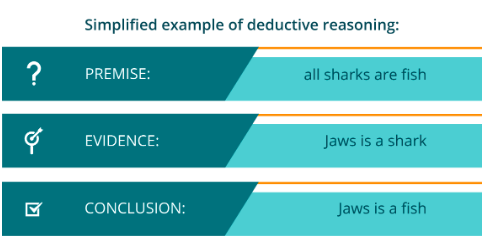
- Premise 1: All mammals are warm-blooded.
- Premise 2: A dog is a mammal.
Conclusion:
Therefore, a dog is warm-blooded.
In this example, the conclusion is derived from the general premise that all mammals are warm-blooded and the specific premise that a dog is a mammal.
4. Components of deductive reasoning:
a. Premises:
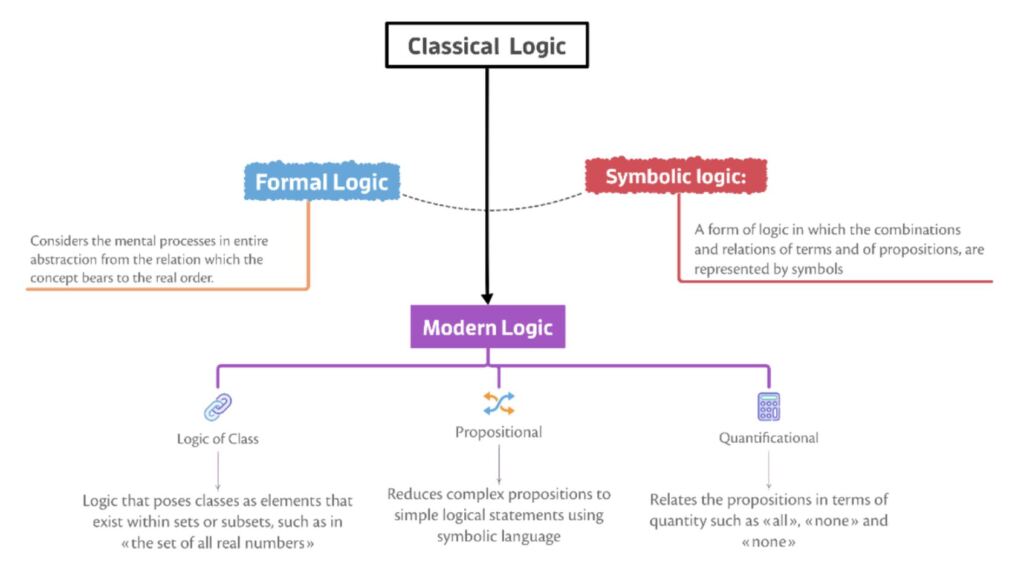
Premises are statements or assertions that provide the basis for the logical argument. They are accepted as true or assumed to be true for the sake of the argument. In deductive reasoning, the validity of the conclusion depends on the truthfulness of the premises.
b. Logical connections:
Logical connections refer to the relationships between the premises and the conclusion. These connections must follow valid logical principles, such as the rules of deduction, to ensure that the conclusion logically follows from the premises.
c. Conclusion:
The conclusion is the final statement or inference reached through deductive reasoning. It is a specific statement that logically follows from the premises.
5. Practice exercise:
Identify whether the following arguments are examples of deductive reasoning or not. If they are, also identify the premises and the conclusion.
a. Premise 1:
All birds have feathers.
Premise 2:
Penguins are birds.
Conclusion:
Therefore, penguins have feathers.
b. Premise 1:
If it rains, the ground will get wet.
Premise 2:
It is raining.
Conclusion:
Therefore, the ground will get wet.
c. Premise 1:
All triangles have three sides.
Premise 2:
This shape has three sides
Conclusion:
Therefore, this shape is a triangle.
Answers:
a. Deductive reasoning
Premises: All birds have feathers; Penguins are birds.
Conclusion:
Therefore, penguins have feathers.
b. Deductive reasoning
Premises: If it rains, the ground will get wet; It is raining.
Conclusion:
Therefore, the ground will get wet.
c. Deductive reasoning
Premises: All triangles have three sides; This shape has three sides.
Conclusion:
Therefore, this shape is a triangle.
III. Inductive Reasoning
1. Definition of Inductive Reasoning:
Inductive reasoning is a form of logical thinking that involves making generalizations or reaching conclusions based on specific observations or evidence. It involves moving from specific instances to broader generalizations or predictions.
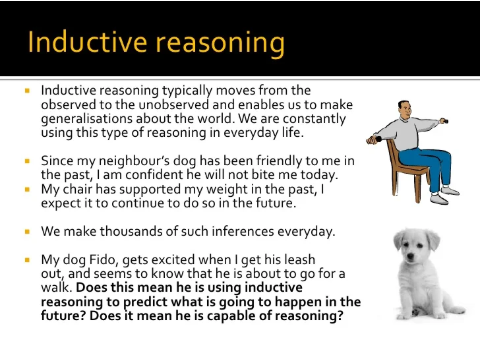
Inductive reasoning is a valuable cognitive tool that humans use for various purposes in everyday life and in fields such as science, philosophy, and decision-making. Here are some reasons why inductive reasoning is important and why it is commonly employed:
a. Generalization:
Inductive reasoning allows us to make generalizations based on specific observations or evidence. When we observe a pattern or trend in a limited set of data, we can use inductive reasoning to generalize that pattern to a broader population or set of circumstances. This is particularly useful when we don’t have access to all possible data points.
b. Prediction:
Inductive reasoning can help us make predictions about future events or outcomes. If we have observed a consistent pattern in the past, we can use inductive reasoning to predict that the same pattern will continue in the future, even though we cannot be certain.
c. Problem Solving:
Inductive reasoning is often used in problem-solving, especially when dealing with incomplete or uncertain information. It allows us to generate hypotheses and possible solutions based on available evidence and past experiences.
d. Scientific Inquiry:
In science, inductive reasoning plays a crucial role in the formation of hypotheses and theories. Scientists make observations and gather data, and then they use inductive reasoning to develop hypotheses and theories that explain and generalize those observations.
e. Decision-Making:
Inductive reasoning is used in decision-making processes to assess the likelihood of various outcomes. When making choices, people often rely on past experiences and observed patterns to estimate the consequences of their decisions.
f. Learning:
Inductive reasoning is an essential part of the learning process. When we encounter new information or experiences, we often use inductive reasoning to make sense of them and integrate them into our existing knowledge and understanding.
While inductive reasoning is a powerful tool, it is important to note that it does not guarantee absolute certainty. Inductive conclusions are probabilistic in nature, meaning they are based on the likelihood of an event or pattern continuing based on past observations.
As a result, there is always some degree of uncertainty associated with inductive reasoning, and it can be subject to biases and errors. Nonetheless, it remains a valuable and practical method for making sense of the world around us and making informed decisions.
2. Characteristics of Inductive Reasoning:
- Scientific Research: Inductive reasoning is common in scientific research to develop hypotheses and theories.
- Data Analysis: When analyzing data to identify patterns, trends, and correlations.
- Everyday Problem Solving: In situations where you don't have access to complete information, you can make educated guesses based on available evidence.
3. Example of Inductive Reasoning:
Example:
Every time you have eaten strawberries, they have been sweet. Therefore, you conclude that all strawberries are sweet.
In this example, the conclusion is based on the observation that every time you have encountered strawberries, they have been sweet. You make a generalization that all strawberries are sweet based on this observation.
4. Components of Inductive Reasoning:
Observation:
Inductive reasoning begins with specific observations or data points. These observations can be derived from personal experiences, experiments, surveys, or any other relevant sources.
Patterns and Generalizations:
Inductive reasoning involves recognizing patterns or regularities in the observed data and using them to form generalizations or hypotheses about a broader group or situation.
Hypothesis or Prediction:
Based on the patterns and generalizations identified, inductive reasoning allows for the formation of hypotheses or predictions about future instances or situations.
5. Practice Exercise:
Consider the following scenarios and determine if they involve inductive reasoning:
Scenario 1:
Mary notices that every time she waters her plants, they grow faster. She concludes that watering helps plants grow faster.
Scenario 2:
Tom observes that all the cats he has encountered have fur. He concludes that all cats have fur.
Scenario 3:
Alex conducts a survey of 100 people and finds that 80% of them prefer coffee over tea. Based on this, Alex predicts that the majority of people in the city prefer coffee.
Scenario 4:
Sarah observes that whenever she wears her lucky charm, she performs well in exams. She concludes that her lucky charm brings good luck in exams.
Answers:
Scenario 1: Yes, it involves inductive reasoning.
Scenario 2: Yes, it involves inductive reasoning.
Scenario 3: Yes, it involves inductive reasoning.
Scenario 4: Yes, it involves inductive reasoning.
In each scenario, the conclusion is based on specific observations and is generalized to a broader context.
IV. Comparison of Deductive and Inductive Reasoning
1. Key differences between deductive and inductive reasoning:
| Contents | Deductive | Inductive |
|---|---|---|
|
Definition |
Deductive reasoning is a form of reasoning where the conclusion logically follows from the premises. It is based on established rules, principles, or generalizations. |
Deductive reasoning is a form of reasoning where the conclusion logically follows from the premises. It is based on established rules, principles, or generalizations. |
|
Nature of
Reasoning |
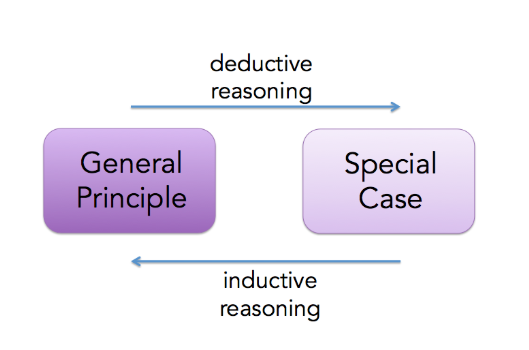
Deductive reasoning is a top-down approach, starting from general principles and moving towards specific conclusions. |
Inductive reasoning is a bottom-up approach, starting from specific observations and patterns and moving towards general conclusions. |
|
Certainty
of
Conclusion |
Deductive reasoning provides certainty in the conclusion if the premises are true and the logical connections are valid |
Inductive reasoning provides probability or likelihood in the conclusion, as it is based on observed patterns or trends but does not guarantee absolute certainty. |
|
Generalization |
Deductive reasoning typically moves from the general to the specific, using universal principles or rules to draw conclusions about particular cases. |
Deductive reasoning typically moves from the general to the specific, using universal principles or rules to draw conclusions about particular cases. |
|
Risk of Error |
Deductive reasoning is more prone to error if any of the premises or logical connections are false or invalid. |
Inductive reasoning is more prone to error due to the possibility of drawing inaccurate generalizations from limited observations. |
2. Examples highlighting the contrast between deductive and inductive reasoning:
a. Example of Deductive Reasoning:
- Premise 1: All mammals have lungs.
- Premise 2: A dog is a mammals.
- Conclusion: Therefore, a dog has lungs.
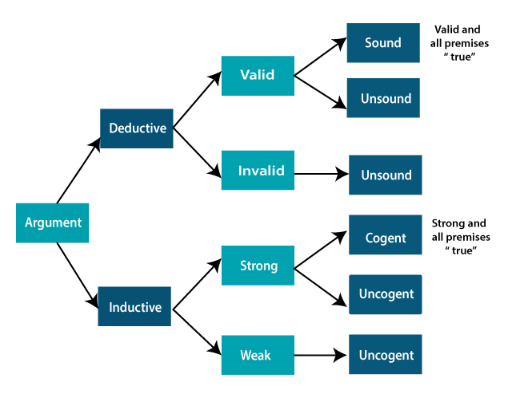
In this example, the conclusion logically follows from the premises using deductive reasoning.
b. Example of Inductive Reasoning:
- Observation: Every time it has rained, the streets have become wet.
- Generalization: Therefore, whenever it rains, the streets will become wet.
In this example, the conclusion is based on specific observations and is generalized using inductive reasoning.
c. Deductive Reasoning in Mathematics:
- Premise 1: All squares have four sides of equal length.
- Premise 2: Figure X is a square.
Conclusion:
Therefore, figure X has four sides of equal length.
Note
The conclusion is derived through deductive reasoning, applying the known properties of squares.
d. Inductive Reasoning in Science:
- Observation: Every time a chemical reaction occurs, heat is released.
- Generalization: Therefore, it can be inferred that chemical reactions generally produce heat.
The generalization is based on repeated observations and serves as an example of inductive reasoning in science.
Note
These examples showcase the contrasting characteristics of deductive and inductive reasoning, emphasizing their different approaches and outcomes. It is important to note that both forms of reasoning have their own strengths and limitations, and their appropriateness depends on the context and nature of the problem or situation at hand.
V. Real-life Applications
1. Deductive reasoning in science:
- Scientists use deductive reasoning to develop and test hypotheses based on existing theories or principles.
- Deductive reasoning helps scientists make predictions and draw conclusions based on established laws or principles.
- Example: If all mammals have hair, and a dolphin is a mammal, then we can deduce that dolphins have hair.
2. Inductive reasoning in research:
- Researchers use inductive reasoning to draw generalizations or patterns based on observations or data
- Inductive reasoning allows researchers to form hypotheses or theories based on the available evidence.
- Example: After observing that all observed apples have been red, we can induce that all apples are red.
3. Deductive and inductive reasoning in legal and investigative processes:
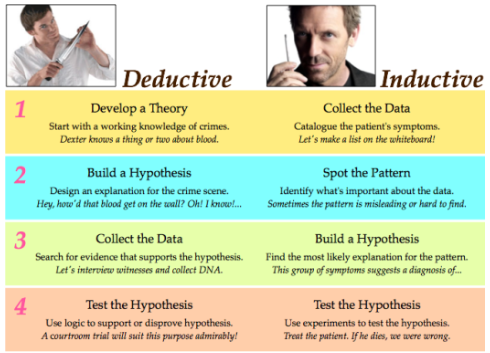
- Deductive reasoning is used in legal arguments to reach logical conclusions based on established laws, rules, and precedents
- Inductive reasoning is used in criminal investigations to develop hypotheses and identify patterns or trends based on available evidence.
- Example: Deductive reasoning is employed in a court of law to establish guilt or innocence based on evidence and legal principles.
VI. Problem Solving using Deductive and Inductive Reasoning
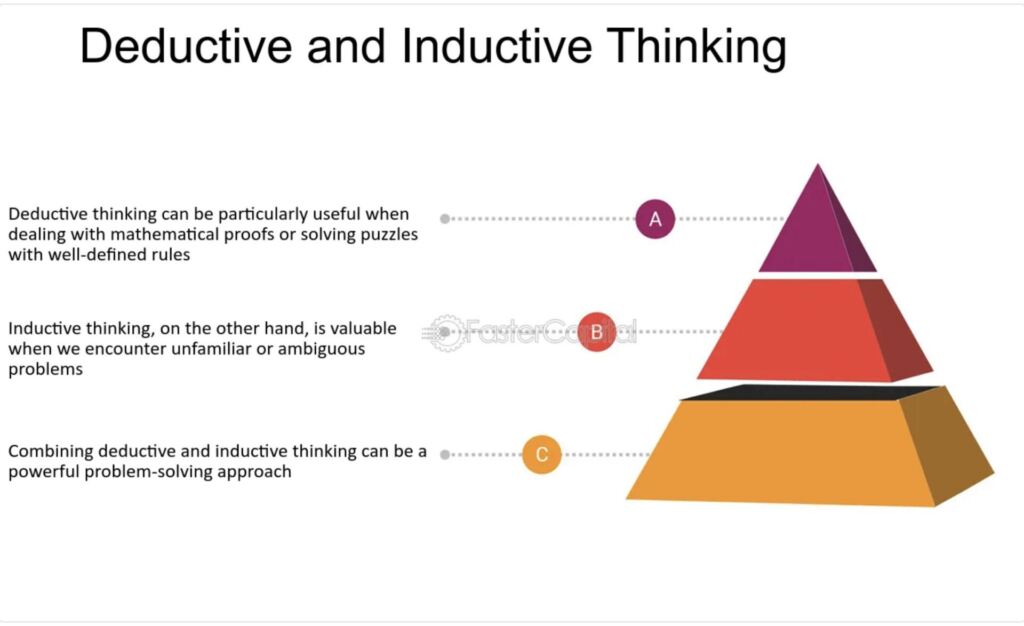
Deductive and inductive reasoning are two fundamental methods for problem solving and drawing conclusions. They operate differently, and each has its strengths and weaknesses. Here’s an overview of how each method works and when to use them:
1. Deductive Reasoning:
Deductive reasoning starts with a general premise or statement and uses it to reach a specific, logically certain conclusion. It follows a structured and formal process, often represented as a syllogism:
• a. All men are mortal. (General premise)
• b. Socrates is a man. (Specific premise)
• c. Therefore, Socrates is mortal. (Specific conclusion)
Key characteristics of deductive reasoning:
-It is based on established principles or premises.
– The conclusion is certain if the premises are true.
– It is used to validate or test the validity of arguments.
– Deductive reasoning is used in mathematics, formal logic, and structured problem solving.
2. Inductive Reasoning:
Inductive reasoning, on the other hand, starts with specific observations or evidence and uses them to make broader generalizations or predictions. It does not guarantee certainty, but it suggests the likelihood of a conclusion being true based on the available evidence.
For example, if you observe that every crow you’ve seen is black, you might inductively reason that all crows are black. However, this conclusion is not certain, as there could be exceptions
Key characteristics of inductive reasoning:
– It uses specific observations or evidence to make generalizations.
– The conclusion is probabilistic and subject to revision as new evidence emerges.
– It is used in scientific research, data analysis, and everyday problem solving.
3. When to Use Deductive Reasoning:
Formal Logic:
Deductive reasoning is crucial in formal logic and mathematical proofs.
Validity Testing:
Use it when you need to determine whether an argument is logically valid.
Certainty:
When you need to reach a conclusion with a high degree of certainty, provided the premises are true.
4. When to Use Inductive Reasoning:
- Scientific Research: Inductive reasoning is common in scientific research to develop hypotheses and theories.
- Data Analysis: When analyzing data to identify patterns, trends, and correlations.
- Everyday Problem Solving: In situations where you don't have access to complete information, you can make educated guesses based on available evidence.
In practice, deductive and inductive reasoning often work together. Inductive reasoning can generate hypotheses and ideas, while deductive reasoning can be used to test and validate them. Effective problem solving often requires a balance of both approaches, depending on the nature of the problem and the available information.
Conclusion
In conclusion, deductive and inductive reasoning are essential tools for logical thinking and problem-solving. Deductive reasoning allows for precise conclusions based on given premises, while inductive reasoning enables generalizations and predictions based on patterns and observations. By understanding and applying these reasoning methods, we can make informed decisions and navigate complex situations effectively. Remember to continue practicing and exploring deductive and inductive reasoning to sharpen your critical thinking skills and enhance your problem-solving abilities.