


Lesson 7 – How to Calculate with Ratios and Proportions
Introduction
Mathematical notions like proportions and ratios compare two quantities concerning one another. Numerous areas of mathematics, science, and daily life require an understanding of proportions and ratios.
I. Definition
1. Proportion
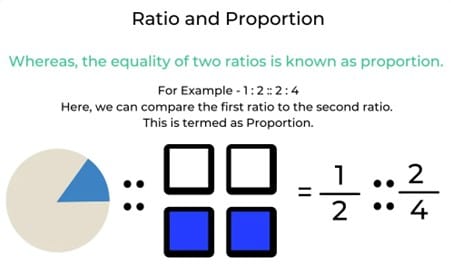
The connection between two or more numbers or values is called a proportion. Particularly, proportions compare two ratios and establish their relationship.
In an equation, a proportion is often written as two equal ratios.
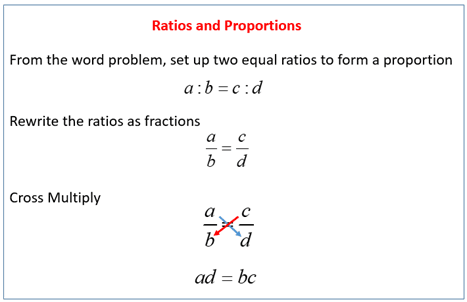
We have two proportions, A : B and C : D; we can write like this: A : B = C : D, where a, b, c, and d are all numerical values.
This expression represents the proportions of A to B equal to those of C to D. To find an unknown value in the expression; we use cross-multiplication that makes the two ratios equal.
2. Ratio
The ratio is a comparison between two things or values. To express ratios as fractions, one value is often placed in the numerator and the other in the denominator.
Comparing distinct units of measurement, such as length, weight, or volume, can be done using ratios.
We have two ratios, A and B; the ratio of A to B can be written as A : B or \( \frac{𝐴}{𝐵}\)
The ratio of A to B indicates how many times larger (or smaller) A is than B.
3. Properties
Scaling:
The scale can increase or decrease based on the multiplication or division of both values by the same number.
Example, the ratio 2:3 will increase when multiplying both values by 2 => 4:6
Similar property:
Ratios are always equal. We can check by cross-multiplication. Multiply the numerator of one ratio by the denominator of the other, and vice versa. If the cross products are equal, then the two ratios are equal.
Example: 3 : 2 = 6 : 4 => 3.4 = 2.6 => 12 = 12
Proportional:
If two ratios are equal, then they are proportional. Apply cross-multiplication.
Invertibility:
The inverse of the ratio A : B is the ratio B : A. Inverting a ratio helps solve ratio-related problems.
The transitive property:
If two ratios are equal to a third ratio, they are equal. This property is often used in proofs involving proportions.
We can simplify problems, solve equations, and precisely compare quantities by applying these properties.
Applications for ratios and proportions are numerous, ranging from baking and cooking to banking and engineering. They are a crucial component of many mathematical concepts, including fractions, decimals, and percentages, and can assist us in making comparisons and resolving issues methodically and logically.
II. Explanation
1. Ratio and Proportion Formula
Ratio Formula:
The ratio formula compares two quantities or numbers. It can be expressed as:
Ratio = A : B or Ratio = \( \frac{𝐴}{𝐵}\)
Proportion Formula:
A proportion is an equation that states that two ratios are equal. It can be written as:
A : B = C : D or \( \frac{𝐴}{𝐵}\) = \( \frac{𝐶}{𝐷}\)
2. Example:
Ratio Formula: A recipe we have called for a 2:1 ratio of flour to sugar. The ratio formula can be used to determine how much sugar to use if we need 4 cups of flour.
- Ratio = Flour : Sugar = 2 : 1
- To find the amount of sugar:
- Sugar = \( \frac{𝐹𝑙𝑜𝑢𝑟 . 𝑅𝑎𝑡𝑖𝑜 𝑜𝑓 𝑆𝑢𝑔𝑎𝑟}{𝑅𝑎𝑡𝑖𝑜 𝑜𝑓 𝐹𝑙𝑜𝑢𝑟}\) = \( \frac{4.1}{2}\) = \( \frac{4}{2}\) = 2 cups
- If we need 4 cups of flour, we would need 2 cups of sugar to maintain the ratio of 2:1
Proportion Formula: How many workers are required to finish the same project in 6 days if 8 workers can finish it in 12?
- Set up the proportion using the proportion formula:
- Workers : Days = Workers : Days = 8 : 12 = x : 6
- To find the unknown number of workers (x), use the cross-multiplication method: 8 x 6 = 12x 48 = 12x
- Dividing both sides of the equation by 12: x = \( \frac{48}{12}\) => x = 4
- 4 workers are needed to complete the project in 6 days.
Conclusion
Mathematics’ basic notions of proportions and ratios are used to compare quantities and express their relationships. Proportions and ratios are applied in many real-world circumstances, including in economics, science, and engineering. Understanding the fundamental concepts, such as how to establish and solve proportions, locate equivalent ratios, and simplify ratios, is crucial when working with proportions and ratios. The ability to convert between fractions, decimals, and percentages is also vital.