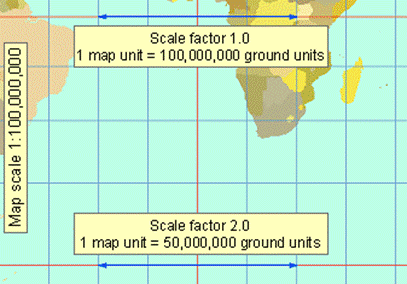


Lesson 2 – Scale Factor
Introduction
A scale factor is a number the scales or resizes the shape. It is the ratio of the length or size of the image to the corresponding height or size of the original object.
In geometry, the scale factor is the ratio between the corresponding sides of two similar shapes. It describes how the size of one shape compares to another similar figure. The scale factor is an essential concept in geometry, as it helps us understand and compare different forms’ sizes.
In this lesson, we will learn a scale factor and how to calculate it using the corresponding sides of two similar shapes. Scale Factor content helps you grasp properties of similar shapes, including how complementary angles are equal and how corresponding sides are proportional. Additionally, we will practice solving problems related to ratio coefficients and similar numbers together.
I. Definition of scale factor:
1.
A scale factor is a number that represents the ratio of the size of the original shape to the size of the enlarged or reduced image. It is used in geometry to describe a proportional relationship between two similar figures. The scale factor is calculated by dividing the two figures' lengths, width, or height. It is usually denoted by the symbol "k."
2.
The scale factor is a dimensionless quantity; it does not have any units. It is simply a ratio of two lengths or dimensions.
3.
The scale factor is an essential concept in geometry, especially in transformations such as dilation and homogeneity. It is also used in physics and engineering to describe changes in the size or dimension of a physical quantity or object.
II. Formula
1.
Let a and b be two quantities proportional to each other according to the formula a = k.b (k is a non-zero constant). Then we have the formula k= a/b
2.
The formula for the scaling factor depends on the context in which it is being used.
3.
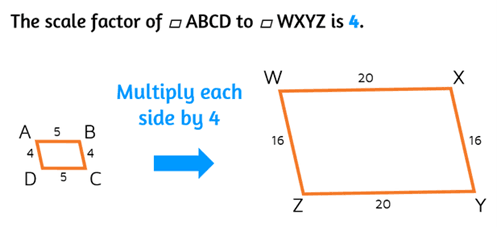
In geometry, the ratio coefficient between two similar figures or shapes can be found by dividing the lengths of the corresponding sides of the two figures.
4.
If we have two similar triangles with side lengths a, b, c and a', b', c' respectively, then the scale factor from the first triangle to the second triangle is given by scale factor = a' / a = b' / b = c' / c
5.
This formula tells us that the ratio of any corresponding side lengths of the two triangles is the same and that this standard ratio is the scaling factor.
6.
In physics and engineering, scale factors are often used to describe changes in the size or dimensions of physical quantities or objects.
7.
The formula for the scaling factor in these contexts depends on the specific amount to be scaled. If we want to scale the distance between two points by a factor k, then the new space is given by further distance = k * actual distance.
8.
The scaling factor is multiplied by the actual distance to get the new space.
9.
Similarly, if we want to scale an object's mass by a factor of k, the new mass is given by new mass = k * original mass.
10.
The scaling factor is multiplied by the original mass to obtain the new mass. The formula for the scale factor depends on the context in which it is being used. Still, it often includes ratios or multiplications of quantities to describe changes in size or dimension.
11.
If two quantities, x; y, are proportional to each other. The ratio of their respective values remains constant. That constant value is the scaling factor.
12.
If two quantities, x; y, are inversely proportional. The product of their two values is always constant. That constant value is the scaling factor.
III. Examples
1.
There is a triangle with a side of 3 cm, and we want to scale it by a factor (4:6). Then we need to multiply the side by the scale factor: 3 x 4 = 12 and 3 x 6 = 18
2.
Let two quantities, x, and y, be proportional to each other. Know x1=3; y1=6. Find the scaling factor of y concerning x in the following cases:
a) y is proportional to x
Since y and x are proportional, we have the scaling factor:
k = \( \frac{y1}{x1}\) = \( \frac{6}{3}\) = 2
=> 2 is the scaling factor when y is proportional to x.
b) y is inversely proportional to x
Since y and x are inversely proportional, we have the scaling factor:
a = x1.y1 = 3.6 = 18
=> 18 is the scaling factor when y is inversely proportional to x.
For every 150kg of the paddy, 60 kilograms of rice is given. Ask for 2 tons of rice; how many kg of rice to give?
2 tons = 2000kg.
- The number of kilograms of rice and the number of kilograms of rice is proportional to each other, so we have: y1/x1=y2/x2
With y1= 60kg; x1= 150kg; x2= 2000kg, we have:
\( \frac{60}{150}\) = \( \frac{y2}{2000}\) => 150.y2 = 60.2000 => y2 = \( \frac{120000}{150}\) => y2 = 800
=> So for 2 tons of paddy, we get 800kg of rice.
Conclusion
The scale factor is a mathematical concept used in geometry and other mathematical fields to describe the relationship between two similar figures. It represents the ratio between two shapes: length, width, or height. The scale factor is also used in many real-world applications, such as maps and blueprints.