


Lesson 1 – Mass and Weight
Introduction
In this lesson, we will learn about Mass and Weight. Mass and Weight are two commonly used quantities in Physics; however, many differences exist.
- One of the most important is understanding the difference between Weight and Mass.
- Apply the concepts of Weight and Mass to the exercises to get the correct answer
- Use formulas of weights and volumes based on their relationship to solve the questions.
And through today’s lesson, we will know how to use Mass and Weight correctly in cases
I. Definition
1. Mass
Mass can be considered a measure of how much substance or material an object contains. And it is independent of the medium and position and determines an object’s inertia.

Mass of potato chips is 13 gram
Mass plays a vital role in the laws of motion and gravity. Further, it is also an essential concept in many other areas of physics, including energy, momentum, and quantum mechanics.
2. Weight
Weight is the force exerted on an object due to gravity, and it is a vector quantity, meaning it has both magnitude and direction.
The Weight of an object is proportional to its Mass and acceleration due to gravity.
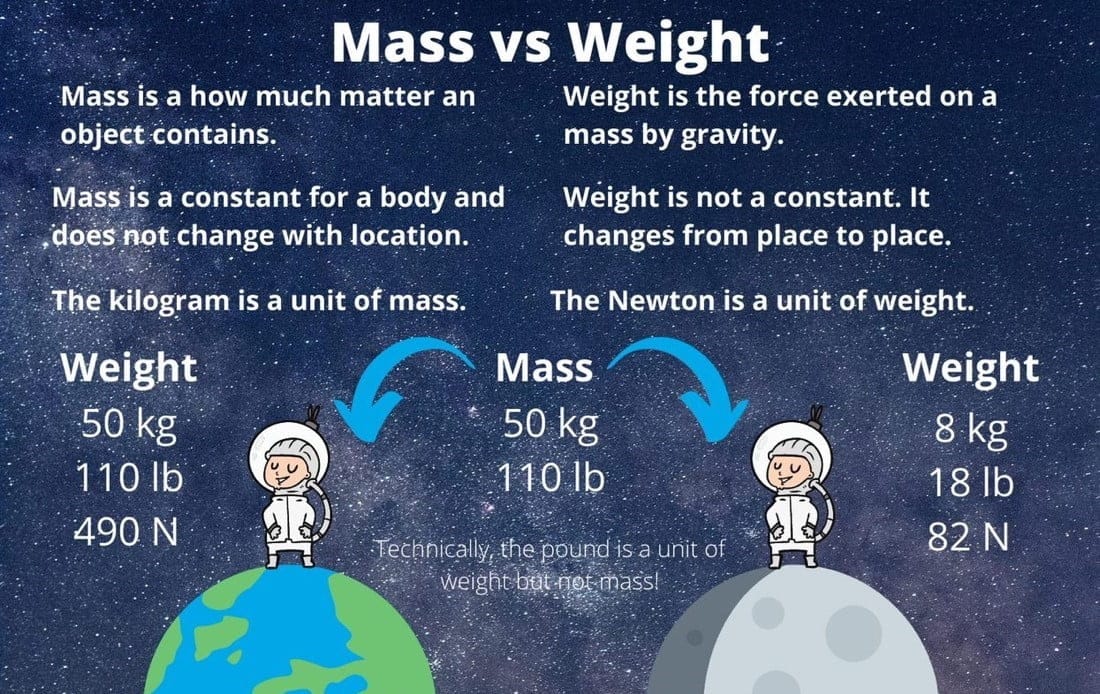
- Differences between Mass and Weight:
Mass and Weight are often confused with each other, but they are two distinct physical quantities. Here are the main differences:
| Mass | Weight | |
|---|---|---|
|
Definition |
Mass is the measure of the amount of matter in an object |
Weight is the magnitude of the gravitational force that the Earth exerts on the object |
|
Units |
It is often denoted using m or M and is measured in units of b kilograms (kg) |
Weight is often represented by the symbol “W” |
|
Independence |
Mass does not depend on the gravitational field it is in |
Weight is a measure of the force that a gravitational field exerts on an object, and it does depend on the strength of the gravitational field. |
|
Scalar vs. Vector Quantity |
Mass has magnitude but no direction (scalar quantity) |
Weight is a vector quantity, it has both magnitude and direction. |
|
Constant vs. Variable |
An object’s mass remains regardless of according to location |
Weight will vary depending on to location |
|
|
Mass is a fundamental property of matter and is conserved in physical processes |
Weight can vary depending on the gravitational field an object |
|
This is why an astronaut’s weight appears to be different on the Moon than on Earth, even though their mass remains the same. |
||
➔ It’s also important to remember that mass and weight are not interchangeable terms
Are Mass and Weight are same thing?
3. Calculation
Calculating Mass and Weight involves different formulas and equations.
a. To calculate Mass:
Weigh the object using a scale that measures in units of kilograms or grams.
The formula for calculating Mass based on the relationship between Weight and Mass is: Mass = weight/acceleration to gravity (m=P/g)m
- M: Mass
- P: Weight
- g: Acceleration to gravity
b. To calculate weight
The formula for calculating Weight by Mass (from the formula for calculating Mass, we can deduce the formula for calculating Weight) is: weight = mass * acceleration to gravity (P=m*g)
- P: Weight
- m or M: Mass
- g: Acceleration to gravity
Note
Weight depends on an object's gravitational field, which can vary by location. In comparison, Mass is an intrinsic property of an object and remains constant regardless of position.
4. Example
1. When you stand on a bathroom scale, the scale measures the force that the Earth’s gravity exerts on your body; the point is called your Weight.
2. An object with a mass of 2 kg would have its Weight on Earth about six times its weight on the Moon because the acceleration due to gravity on Earth is six times higher than the acceleration due to gravity on the Moon.
Conclusion
Mass and weight are both important concepts in physics regarding the properties and behavior of matter.
Mass is a measure of the amount of matter in an object and is a fundamental property that does not change with location. Its value is always constant no matter where it is, whether in a vacuum or water environment, etc. And use a dynamometer to measure it.
Weight is the magnitude or strength of the Earth’s gravity on an object. It depends on the mass of the object and the acceleration due to gravity. Scales are commonly used to determine the mass.
In everyday language, mass is often used interchangeably with weight, but through this lesson, we see that mass and weight are two completely different units.