


Lesson 8 – Distributive Property
Introduction
Welcome to our lesson on distributive property! The distributive property is a powerful tool that helps us simplify and solve mathematical expressions. It allows us to break down complex expressions into smaller parts that are easier to handle. In this lesson, we will explore the fundamental concepts of distributive property and learn how to apply it to solve problems.
We will also practice using the distributive property with simple examples to solidify our understanding. Whether a beginner or an experienced learner, mastering distributive property is a critical skill that will help you excel in mathematics and other fields.
I. Definition
1. What is Distributive property?
The distributive property states that when a number is multiplied by the sum of two or more addends, the same result can be obtained by multiplying each addend individually by the number and then adding the products together.
In other words, according to the distributive property, an expression of form A (B + C) can be solved as A (B + C) = AB + AC.
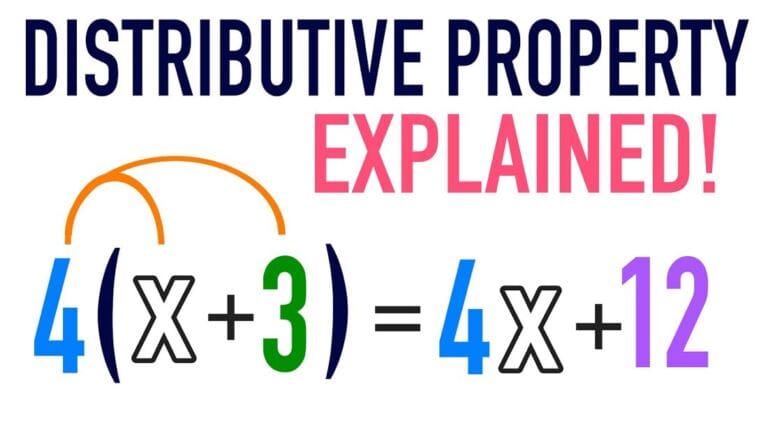
This property applies to subtraction as well.
A (B – C) = AB – AC
This indicates that operand A is shared between the other two operands.
2. Distributive Property Definition
“Distribute” refers to dividing or sharing something. In mathematics, the distributive property refers to the rule that when multiplying a number by the sum or difference of two or more numbers, we can distribute the multiplication operation to each term inside the parentheses. This property is known as the distributive law of multiplication over basic arithmetic operations such as addition or subtraction, and it is a fundamental concept in algebra that helps simplify algebraic expressions and solve equations.
3. Distributive Property of Multiplication over Addition
When we have to multiply a number by the sum of two numbers, we use this property of multiplication over addition. Let’s understand how to use the distributive property better with an example:
Example 1: Solve the expression: 6 (20+5) using the distributive property of multiplication over addition.
Calculate equation 6 (20 + 5), where the number 6 is distributed among the two addends. Simply expressed, we increase each addend by 6 before adding the products.
620+65=120+30=150
Example 2: Solve the expression 2 (2+4) using the distributive property of multiplication over addition.
Solution: 2(2+4)=22+24=4+8=12
If we try to solve this expression using the PEMDAS rule, we’ll have to add the numbers in parentheses and then multiply the total by the number outside the parentheses. This implies:
2(2+4) =2×6= 12
Thus, we get the same result irrespective of the method used.
4. Distributive Property of Multiplication over Subtraction
The distributive property of multiplication over subtraction is a mathematical property that simplifies expressions by distributing multiplication over subtraction. This property allows us to multiply a number or expression with the difference between two other numbers or expressions.
Distributive Property of Multiplication over Subtraction formula:
A(B − C) and AB − AC
are equivalent expressions.
Consider these distributive property examples below.
Example 1: Solve the expression 6(20–5) using the distributive property of multiplication over subtraction.
Solution: Using the distributive property of multiplication over subtraction,
6(20–5)=620–65=120–30=90
Let’s take another example to understand the property better.
Example 2: Solve the expression 2 (4 – 3) using the distributive law of multiplication over subtraction.
Solution: 2(4–3)=24–23=8–6=2
Once more, if we attempt to solve the expression using the order of operations or PEMDAS, we will need to first subtract the numbers inside the parenthesis, then multiply the result by the number outside the parentheses, which implies:
2(4–3)=21=2
The distributive property of subtraction is proven since both techniques give the same result.
5. How to use distributive property?
The distributive property tells us how to simplify an expression with a common factor. When we have an expression in the form of a(b + c), we can use the distributive property to multiply the factor a by each term inside the parenthesis. This is how we use distributive property:
- Step 1: The expression is a(b + c), where a = 3, b = x, and c = 4.
- Step 2: Distribute the factor 3 to each term inside the parenthesis: 3(x + 4) = 3x + 3(4)
- Step 3: Combine the two products obtained and simplify as needed.
- Step 4: Check the solution to ensure it is correct.
Here’s an example: Simplify the expression 3(x + 4)
- Step 1: The expression is in the form of a(b + c), where a = 3, b = x, and c = 4.
- Step 2: Distribute the factor 3 to each term inside the parenthesis: 3(x + 4) = 3x + 3(4)
- Step 3: Simplify the products obtained: 3(x + 4) = 3x + 12
- Step 4: Check the solution: 3(x + 4) can be simplified to 3x + 12 and we have employed distributive property correctly.
Using distributive property simplifies expressions and helps us solve problems efficiently.
II. Application
Let’s solve an application of Distributive property in the word problems.
Problem: A construction company charges a fixed price of $5000 for a project, plus $100 per hour for each hour worked. If the project takes 40 hours, what will be the total cost?
Solutions: We can use the distributive property to find the total cost.
The fixed price is $5000, and the hourly rate is $100 per hour. Therefore, the total cost can be written as:
Total cost = Fixed Price + Hourly Rate x Hours Worked = $5000 + $100 x 40
= $5000 + $4000
= $9000
We used the distributive property to simplify the calculation by multiplying the hourly rate by the number of hours worked and then adding it to the fixed price. The distributive property allowed us to break down the complex expression into simpler parts.
III. Guided Practice
For 15 mins, students need to work in pair/groups to solve the questions given. To ensure students understand how to apply the distributive property to these problems.
Example: 5×(7−3)=(5×7)–(5×3)
Solution: LHS: 5 × (7-3) =20
RHS: (5×7)−(5×3) =(35)-(15) =20
Since LHS = RHS
IV. Independent Practice
For the next 15 mins, students must work independently to practice and solve these examples to improve their skills.
Example 1: Simplify the following expressions using the distributive property:
a) 4(x + 2) = 4x + 8. We distribute the 4 to both terms inside the parenthesis.
b) 5(3y – 7) = 15y – 35. We distribute the 5 to both terms inside the parenthesis.
c) 2(5a – 3b + 4c) = 10a – 6b + 8c We distribute the 2 to all the terms inside the parenthesis.
Example 2: A store sells shirts for $15 each and pants for $25 each. If a customer wants to buy 2 shirts and 4 pants, how much will it cost? Use the distributive property to solve.
Solution:
To solve this problem using the distributive property, we can find the cost of 2 shirts and 4 pants separately and then add them together.
The cost of 2 shirts can be written as 2 x $15 = $30
Similarly, the cost of 4 pants can be written as 4 x $25 = $100
Now, to find the total cost of 2 shirts and 4 pants, we can use the distributive property:
2 x $15 + 4 x $25 = (2 + 4) x $25 = 6 x $25 = $150
Therefore, it will cost $150 for the customer to buy 2 shirts and 4 pairs of pants from the store.
Conclusion
In conclusion, this property is a fundamental concept in mathematics and algebra. It is a powerful tool that allows us to simplify expressions, solve equations, and solve practical problems involving area, cost, and other real-life scenarios. The distributive property states that when we multiply a number by the sum or difference of two or more numbers, we can distribute the multiplication to each term inside the parentheses, simplifying the expression. Mastering the distributive property can solve more complex problems and better understand algebraic concepts. In summary, the distributive property is a crucial concept in mathematics, and learning it is essential for success in algebra and beyond.