


Lesson 7 – Division Property of Equality
Introduction
Welcome to the lesson on the Division of Property of Equality. In mathematics, the concept of equality is fundamental in solving equations. The division property of equality is one of the core principles that help us to understand and manipulate equations and inequalities involving division. This property states that the two expressions remain equal if both sides of an equation are divided by the same non-zero number.
In this lesson, we will explore the division property of equality and its applications in solving equations and inequalities. You will learn how to apply this property to simplify to solve equations involving division.
By the end of this lesson, you will have a solid understanding of the division property of equality and be able to apply it in various mathematical contexts. Let’s get started!
I. Definition
1. What is the Division Property of Equality?
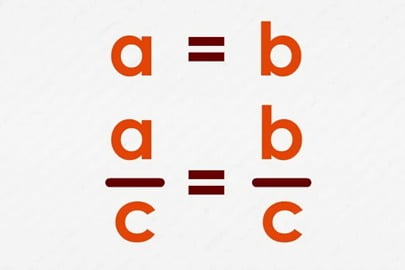
The division Property of Equality is a fundamental property of mathematics that states that if both sides of an equation are divided by the same non-zero number, the equation remains true.
\[ \text{In other words, if } a = b, \text{ then } \frac{a}{c} = \frac{b}{c}, \text{ which } c \neq 0 \]
2. Division Property of Equality definition
The division property of equality indicates that to maintain balance in an equation, we need to divide both sides of the equation by the same non-zero number.
In other words, when we divide one side of an equation by a certain number, we must also divide the other side by the same number to ensure that the equation remains true. This property is essential for solving equations involving variables and simplifying expressions.
3. Division Property of Equality formula
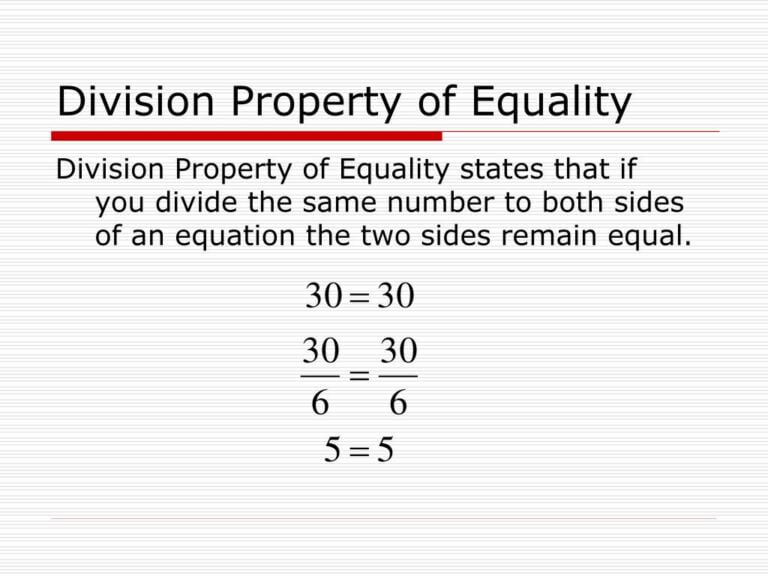
Here is the formula of the Division Property of Equality:
If a=b and C ≠ 0
\[ \text{Then } \frac{a}{c} = \frac{b}{c} \]
4. For examples and non-examples of Divison Property of Equality
For example:
If 6x = 18 => use the division property of equality to solve for x by dividing both sides by 6.
Solutions: \[ \frac{6x}{6} = \frac{18}{6} \]
=> x = 3
Example 2: If (2x + 3)/5 = 7, we can use the division property of equality to solve for x by multiplying both sides by 5 and then dividing by 2.
Solution:
\[ \frac{2x + 3}{5} = 7 \]
(2x + 3) = 35
2x = 32
x = 16
\[ \text{Therefore, } x = 16 \text{ is the solution to the equation } \frac{2x + 3}{5} = 7. \]
For non-examples:
Example 1: If 6x = 18, we cannot use the division property of equality to solve for x by dividing one side by 6 and the other by a different number.
Solution:
5(6x) = 5(18)
30x = 90
Dividing both sides by 30 gives us:
x = 3
\[\text{If } \frac{2x + 3}{5} = 7, \text{ we cannot use the division property of equality to solve for } x \text{ by dividing one side by 5 and the other by 2. For example: }\]
\[ \frac{2x + 3}{2} = 35 \]
2x + 3 = 70
2x = 67
x = 33.5
This is not the correct solution and was not obtained using the division property of equality.
II. Application
A company sells t-shirts for $15 each. If they make a profit of $300, how many t-shirts did they sell?
Solution: Let the number of t-shirts sold be x. The profit made on x t-shirts is $300. We can use the division property of equality to solve for x:
\[ \text{Profit per t-shirt} = \frac{\text{Total profit}}{\text{Number of t-shirts}} = \frac{300}{x} \]
Multiplying both sides by x gives us:
15x = 300
Dividing both sides by 15 gives us:
x = 20
Therefore, the company sold 20 t-shirts to make a profit of $300.
III. Guided Practice
For 15 mins, students have to work in pair/groups to practice problems that require the use of the division property of equality to solve. Encourage the students to work together to solve the problems and check each other’s work.
The example for each group is:
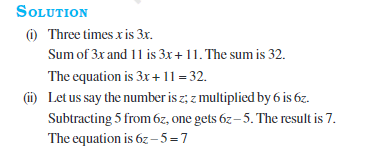
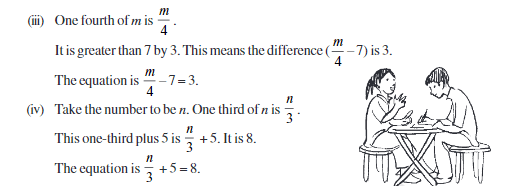
Example 1: Write the following statements in the form of equations:
(i) The sum of three times x and 11 is 32.
(ii) If you subtract 5 from 6 times a number, you get 7.
(iii) One fourth of m is 3 more than 7.
(iv) One third of a number plus 5 is 8.
IV. Independent Practice
For the next 15 mins, students must work independently to solve these questions. Encourage students to use the knowledge of division of equality to solve.
Example 6: Solve 12p – 5 = 25
Solution:
- Adding 5 on both sides of the equation, 12p - 5 + 5 = 25 + 5 or 12p = 30
- \[ \text{Dividing both sides by 12:} \quad \frac{12p}{12} = \frac{30}{12} \quad \text{or} \quad p = \frac{5}{2} \]
Check: \[\text{Putting } p = \frac{5}{2} \text{ in the LHS of equation } 4.12:\]
\[\text{LHS} = 12 \times \frac{5}{2} – 5 = 6 \times 5 – 5\]
= 30 – 5 = 25 = RHS
Note: Adding 5 to both sides is the same as changing the side of (-5).
12p – 5 = 25
12p = 25 + 5
Changing sides is called transposing. While transposing a number, we change its sign.
Conclusion
In conclusion, the Division Property of Equality is an essential concept for solving equations that involve division. By dividing both sides of an equation by the same non-zero number, we can simplify and isolate variables, making it easier to solve for unknown values.
This property is also applicable in solving inequalities involving division. It is crucial to remember that the property only applies when dividing by a non-zero number. Understanding the Division Property of Equality is fundamental for success in algebra and other branches of mathematics.
We hope this lesson has helped you understand this principle and feel more confident in your ability to solve equations involving division. Keep practicing, and with time, you’ll be a master of the Division Property of Equality!