


Lesson 4 – Addition Property of Equality
Introduction
By the end of this lesson, students will understand and be able to apply the Addition Property of Equality to solve equations. They will recognize that adding the same number to both sides of an equation maintains its equality, and they will be able to use this property to isolate variables and find solutions.
I. Definition
1. What is “Addition property of Equality”
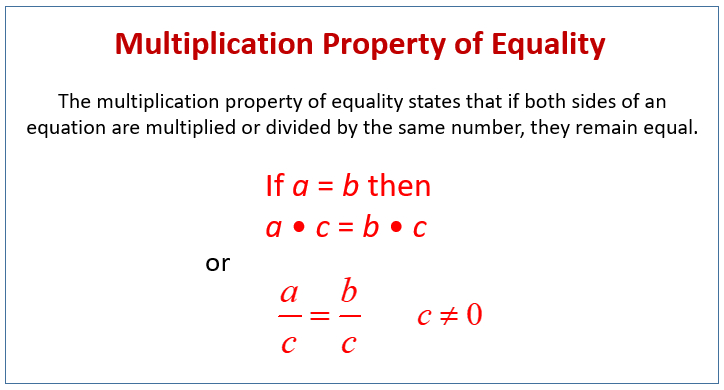
The addition property of equality is a fundamental principle in mathematics that states that if you add the same quantity to both sides of an equation, the equation remains balanced and true.
In other words, adding the same number to both sides of the equation will not change their equality if two quantities are equal.
2. Addition property of Equality formula
The addition property of equality formula is:
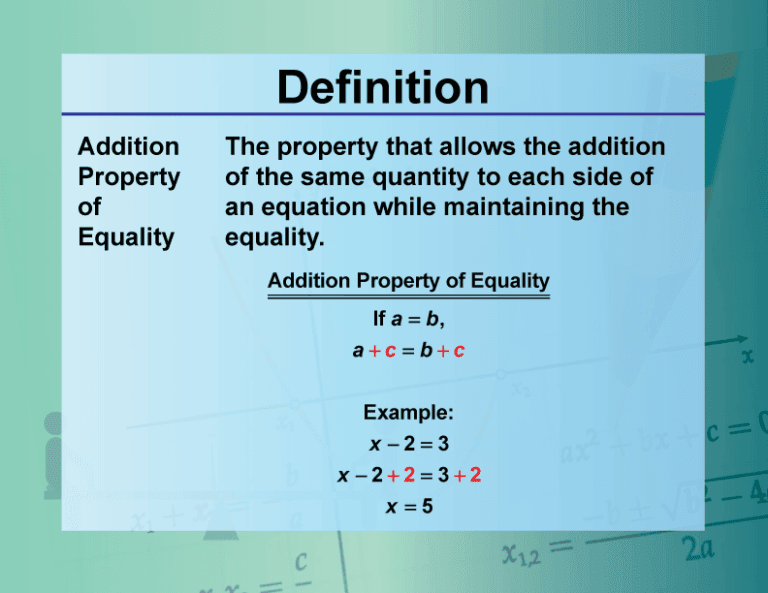
IF A = B, THEN A + C = B + C
Where “a” and “b” are equal quantities, and “c” is any number.
This property allows us to manipulate equations by adding or subtracting the same number to both sides in order to isolate a variable or solve for an unknown value. By using this property, we can simplify equations and solve for the values that make the equation true.
3. Examples and non-examples of Addition property of Equality
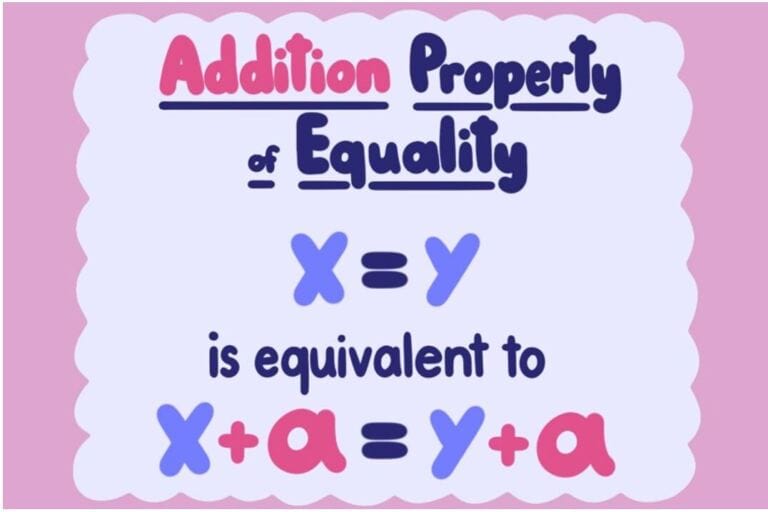
For examples:
If 2x + 3 = 9, then we can use the addition property of equality to add -3 to both sides of the equation, resulting in 2x = 6.
If a + b = c, then we can use the addition property of equality to add x to both sides of the equation, resulting in a + b + x = c + x.
For non-examples:
We are unable to add 4 to both sides of the equation if 3x + 4 = 5x – 1 using the addition principle of equality. Instead, we must first simplify the equation before applying any equality-related properties.
If 2a + 3b = 7, we are unable to add 2a to both sides of the equation using the addition property of equality. This is due to the fact that the property is only applicable when we multiply both sides of the equation by the same amount.
II. Application
Here are some applications that provide word problems related to Addition Property of Equality:
Example 1: Finance: A salesperson earns a basic salary of $500 per week and an additional commission of $50 for each sale. If the salesperson made 10 sales last week, how much did they earn in total?
Solution: To solve this problem, we can use the addition property of equality. We can start by adding the basic salary of $500 to the commission earned from sales.
Let’s use ‘x’ to represent the total earnings of the salesperson. Then, we can write the equation as:
x = 500 + 50(10)
Here, 10 represents the number of sales made by the salesperson. We can simplify the equation using the distributive property of multiplication:
x = 500 + 500
x = 1000
Conclusion
In conclusion, the addition property of equality is a key idea in mathematics. In other words, the addition property of equality enables us to increase both sides of an equation by the same amount without affecting its validity.
When it comes to algebraic expression simplification and problem-solving, this characteristic is extremely helpful. Students have learned how to use the addition property of equality to resolve various word problems and equations during this session. Additionally, they have learned to identify circumstances in which the addition property of equality may be used. Students can improve their proficiency in algebra and other mathematical topics as well as their ability to solve problems in real-world situations by mastering this concept.