


Lesson 6 – Experimental Design
Introduction
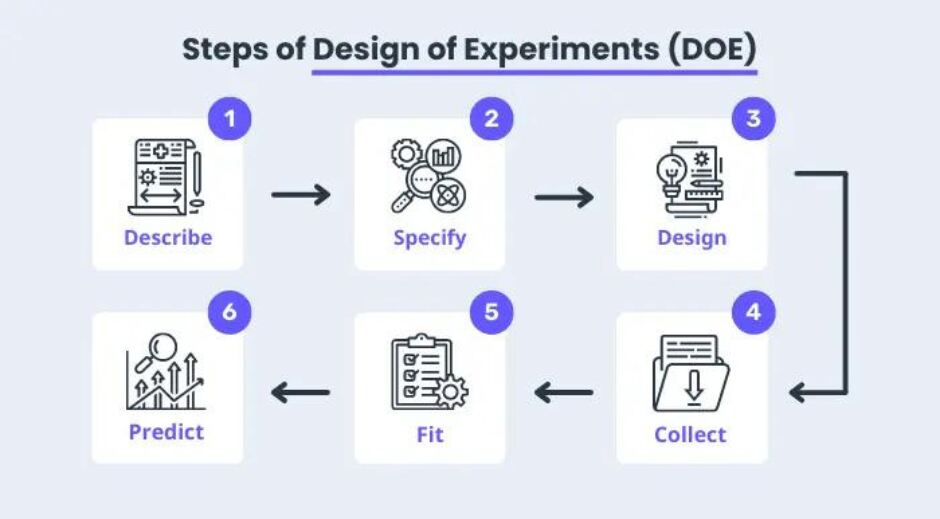
The science of acquiring, observing, computing, and analyzing numerical data is known as statistics. It is jam-packed with tests and analysis. A statistical experiment is described as an organized process to confirm and establish the truth of the hypothesis. Before conducting any experiment, it is essential to explicitly define the exact questions it is designed to answer. The experiment must be constructed to minimize the variability influencing the desired result. Therefore, the researcher will plan the trials to increase precision. It is also known as the design of experiments (DOE) or experimental design. Let’s go over the definition and an example of experimental design in detail in this lesson.
I. Definition
In statistics, the experimental design, also known as the design of experiment (DOE), is described as the layout of an information-gathering investigation in which a variation may or may not be present. Typically, controlled experiments use this phrase. To make the results more reliable, these tests minimize the impacts of the variable. In this design, a group of people, plants, animals, etc., may participate in an experimental unit’s procedure.
II. Method:
There are various types of experimental study designs. As follows:
- Pre-experimental Research Design
- True-experimental Research Design
- Quasi-Experimental Research Design
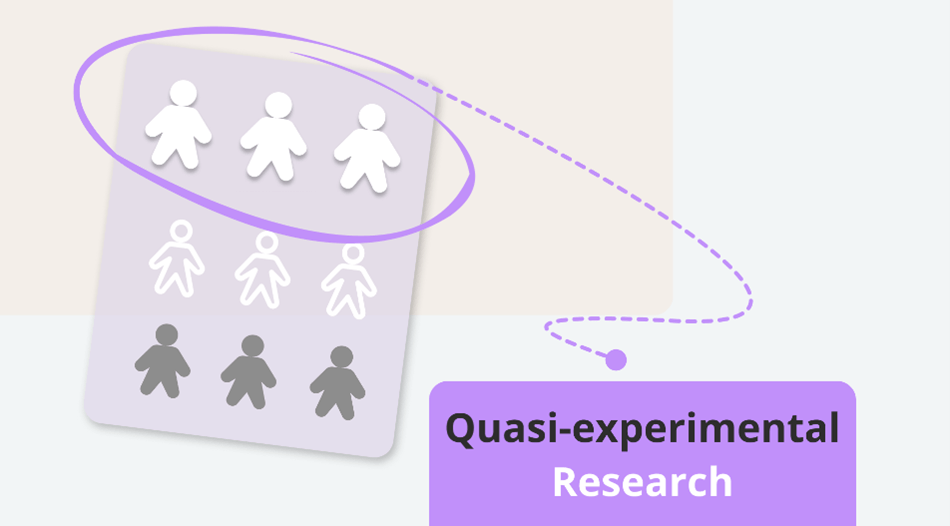
Using examples in this article, we will cover these various experimental designs for research.
1. Pre-experimental Research Design
The pre-experimental research design is the most basic type of statistical experimental research design. In this approach, a group or groups are kept under surveillance after identifying specific factors as the cause and effect. This approach is typically used to determine whether further research is necessary for the target group. Because of this, this procedure is seen as being economical. This approach is divided into three categories:
- Static Group Comparison: This design seeks to compensate for the lack of a control group but must demonstrate whether a change has happened. The static group comparison research selects two groups, one receiving treatment and the other not. After therapy, the difference between the two groups is then measured using a posttest score. As you can see, there is no pre-testing in this study, therefore any differences between the two groups previous to the study are still being determined.
- One-group Pretest-posttest Experimental Research Design: Including a pretest to ascertain baseline scores is a benefit of this design over the previously discussed method. We may use this method to compare college grades before getting job experience to college grades after completing a semester of work experience in our study on college performance. We can now say whether or not there has been a change in the outcome or dependent variable. We cannot say whether this shift would have occurred even if the therapy or independent variable had not been used. The difference in grades was probably driven by maturation rather than work experience.
- One-shot Case Study Experimental Research Design: In this arrangement, subjects are presented with some type of treatment, such as a semester of college work experience, and then the outcome measure is applied, such as college grades. The purpose of this experiment, like all others, is to see if the treatment had any effect on the outcome. It is impossible to assess whether the outcome scores are higher than they would have been without the treatment without a comparison group. Furthermore, without any pre-test scores, it is impossible to identify whether any change has occurred inside the group itself.
2. True-experimental Research Design
This type of experimental study design is the most accurate because it depends on the statistical hypothesis to support or refute the hypothesis. The most popular technique in physical science is this one. Only a true experimental research design can establish a cause-and-effect link between groups. The following conditions must be met for this method to work:
- Random variable: A random variable is a rule that gives each outcome in a sample space a numerical value. Random variables can be discrete or continuous in nature. A discrete random variable is one that takes only specified values in an interval. Otherwise, it is constant. Capital letters, such as X and Y, are commonly used to represent random variables. It is considered to have a discrete random variable if X takes the values 1, 2, 3,...
- The researcher can manipulate the variable.
- Control Groups (A group of participants is familiar with the experimental group, but the practical rules do not apply to them) : In a scientific experiment, a control group is a group that is segregated from the rest of the experiment and where the independent variable being investigated cannot impact the results. This isolates the effects of the independent variable on the experiment and can aid in ruling out alternate explanations for the experimental results.
- Experimental Group (Research participants where practical rules are applied): An experimental group is a test sample or the group that receives an experimental procedure. This group is subjected to changes in the independent variable under consideration. The independent variable's values and the impact on the dependent variable are recorded. At any given time, an experiment may comprise many experimental groups.
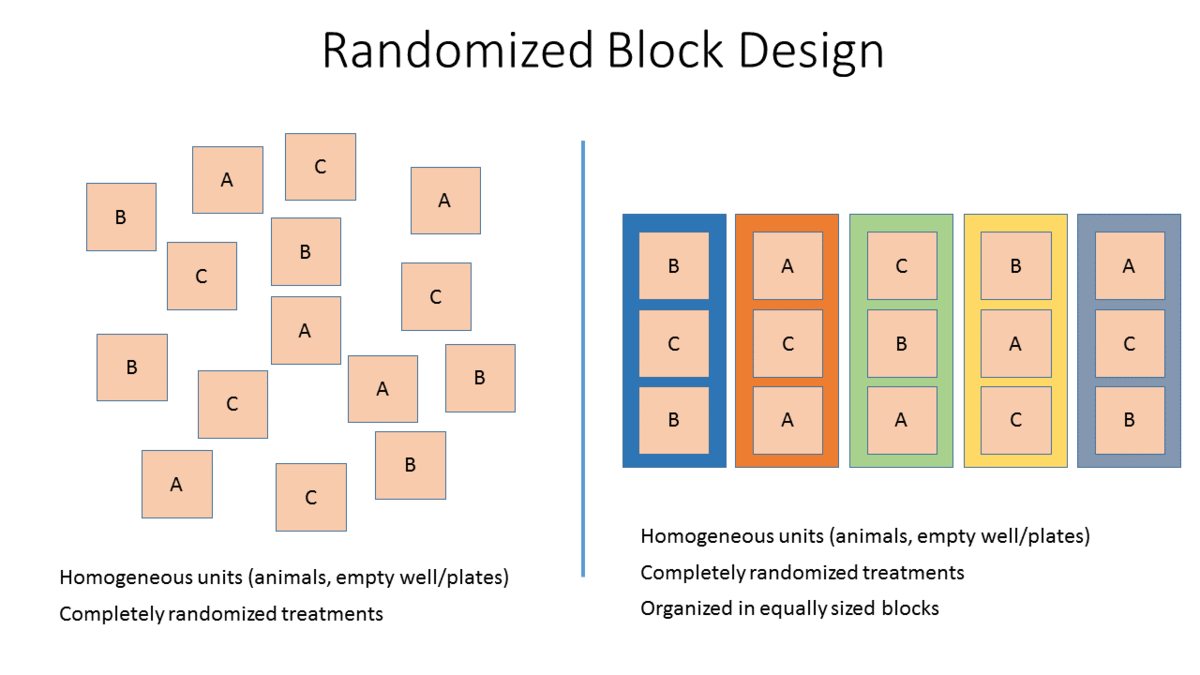
3. Randomised Block Design
When the researcher is certain of the group of objects‘ significant differences, the randomised block design is preferred. The experimental units in this design are divided into smaller groups of comparable categories. These groups are assigned to the treatment group at random. Because of how the blocks are organized, there should be less variation inside each block than there is between them. This block design is very effective in lowering variability and improving estimation.
4. Completely Randomised Design
Of all the types, the simplest type of experimental design is the completely randomized design, in which the participants are randomly assigned to treatment groups. The main advantage of using this method is that it avoids bias and controls the role of chance. This method provides a solid foundation for Statistical analysis as it allows the use of probability theory.
Conclusion
When seeking to determine a cause-and-effect relationship, the experiment, particularly the proper experimental design, is frequently the measure of choice. We can control more confounding variables than any other research approach by using randomization and pre- and post-testing of both an experimental and control group. When these confounding variables are not addressed, the results are frequently erroneous. Controlling confounding variables is critical in research, especially in experimental designs.