


Lesson 7 – How to Develop a Scientific Hypothesis
Introduction
The scientific method is a systematic approach used by scientists to investigate and understand the natural world. A crucial step in this process is developing a hypothesis. In this essay, we will explore the definition of a hypothesis, the steps to develop one, and provide examples to illustrate its application in scientific research.
I. What is a Hypothesis?
1. Definition of a Hypothesis
A hypothesis is a tentative explanation or prediction that can be tested through scientific investigation. It is an educated guess based on prior knowledge, observations, and available evidence. A well-formulated hypothesis guides the research process, providing a clear focus and allowing for systematic experimentation and analysis.
2. Characteristics of a Hypothesis
A hypothesis should possess the following characteristics:
Testability:
A hypothesis must be able to be tested and verified through empirical evidence.
Falsifiability:
A hypothesis should be capable of being proven false if the evidence does not support it.
Clarity:
A hypothesis with specific variables and predictions should be clearly stated.
Specificity:
A hypothesis should address a particular relationship, cause-and-effect, or pattern.
II. How to Develop a Hypothesis
1. Identify the Research Question
The first step in developing a hypothesis is identifying the research question or problem you want to investigate. This question should be specific and focused, allowing for a clear direction in your research.
2. Conduct Background Research
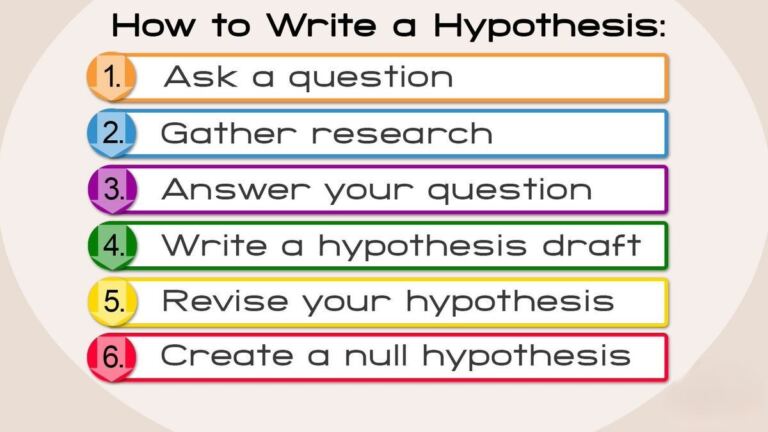
Before formulating a hypothesis, gathering background information on the topic is essential. This includes reviewing existing literature, studies, and observations related to the research question. Understanding previous findings helps inform your hypothesis and ensures that you build upon existing knowledge.
3. Formulate the Hypothesis
Once you clearly understand the research question and relevant background information, it’s time to develop the hypothesis. This involves identifying the independent and dependent variables and proposing a cause-and-effect relationship or prediction.
4. Independent and Dependent Variables:
Independent variable:
The variable that is manipulated or changed by the researcher. It is the factor believed to affect the dependent variable.
Dependent variable:
The variable that is observed or measured. It is the outcome or response that is expected to change as a result of the independent variable.
III. What makes a good hypothesis?
1. Cause and effect
Hypotheses always involve a cause-and-effect relationship, where one variable influences or causes a change in another variable (or no change if using a null hypothesis). This relationship can be expressed using an if-then statement: If one variable occurs, then another variable changes.
2. Testable prediction
Most hypotheses are designed to be tested through experiments (excluding logical hypotheses). Before settling on a hypothesis, ensuring it can be tested is essential. Select a hypothesis that can be experimentally tested and includes an independent variable that can be precisely controlled.
3. Independent and dependent variables
Clearly define the variables in your hypothesis to provide your readers with a comprehensive understanding of the overall context. While it is not necessary to explicitly state which variables are independent or dependent, it is important to mention all the variables involved in the hypothesis.
IV. 7 main types of hypotheses and examples
1. Simple hypothesis
A simple statement hypothesis states that your prediction is true about the relationship between two variables: one independent and one dependent. The experiment will either confirm or deny the statement. Here are a few simple statement hypotheses:
- A less expensive briefcase will fall apart faster than a more expensive briefcase.
- Bringing vegetables to work every day for lunch will cause you to lose weight.
- Drinking four cups of coffee at work every day will increase your blood pressure.
2. Complex hypothesis
A complex hypothesis states a relationship between more than two variables. For example, there might be two independent variables and one dependent or vice versa. Here are some examples of complex hypotheses:
- An office plant watered every three days with cold water will grow faster than one that is watered with hot water.
- Spending three hours or more on social media daily will negatively affect children's mental health and productivity more than adults.
- People who eat fast food have higher chances of having high cholesterol and developing heart disease.
3. Null hypothesis
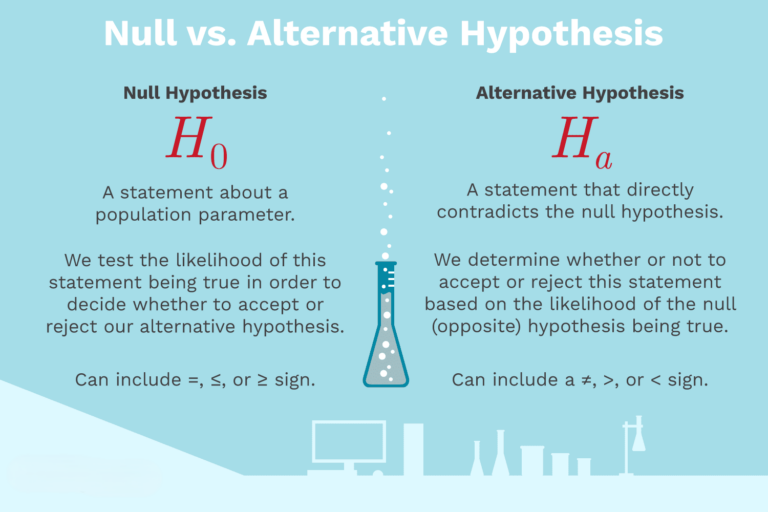
A null hypothesis claims that the original hypothesis is false by showing no relationship between the variables. Here are some examples of null hypotheses:
- Employees do not have a preference for office temperature.
- Employees who write with a pen and paper write at the same rate as employees who use a computer.
- Employees who write with a pen and paper write at the same rate as employees who use a computer.
4. Alternative hypothesis
An alternative hypothesis is used in conjunction with a null hypothesis. It states the opposite of the null hypothesis, so only one must be true. Here are some examples of alternative hypotheses:
- Employees have a preference for office temperature.
- Employees who write with a pen and paper do not write at the same rate as employees who use a computer.
- Physical activity during the workday affects productivity.
5. Logical hypothesis
A logical hypothesis states a relationship between variables based on reasoning or deduction but no actual evidence. Here are some examples of logical hypotheses:
- A unicorn would have trouble scratching its horn when it itches.
- Mermaids can live in water and on land.
- Dogs can’t survive without water.
6. Empirical hypothesis
An empirical hypothesis, also known as a “working hypothesis,” is one that is currently being tested. Unlike a logical hypothesis, it is based on concrete data. Here are some examples of empirical hypotheses:
- A customer will tip the bartender the same amount if the server’s base salary is raised.
- Drinking less reduces the number of employees’ bathroom breaks.
- Exposure to sunlight helps lettuces grow faster.
7. Statistical hypothesis
A statistical hypothesis tests a sample of a group and then applies statistical data to draw a conclusion about the entire group. You test only a portion of the group and generalize the rest based on pre-existing data. Here are some examples of statistical hypotheses:
- In humans, the birth-gender ratio of males to females is 1.05 to 1.00.
- Approximately 2% of the world's population has natural red hair.
- 60% of people talking on the phone while driving have been in at least one car accident.
V. FAQs
1. Should a hypothesis be a single sentence?
While a hypothesis can often be expressed in a single sentence, it may be more complex if the research question involves multiple variables or factors. The key is to ensure it remains clear and testable.
2. Can I create a hypothesis based solely on intuition or personal belief?
Ideally, a scientific hypothesis should be based on existing knowledge, observations, and evidence. While intuition can be a starting point, it should be followed by a review of relevant literature and data to support the hypothesis.
3. What's the difference between a null hypothesis and an alternative hypothesis?
The null hypothesis (H0) is a statement that suggests there is no significant effect or relationship between variables, while the alternative hypothesis (Ha or H1) suggests the presence of an effect or relationship. Researchers typically test the null hypothesis against the alternative hypothesis.
4. Can a hypothesis be proven true or false?
Hypotheses are not “proven” true in the absolute sense. Instead, they are supported or rejected based on experimental evidence. A hypothesis is considered successful if it withstands rigorous testing and is not rejected.
5. What happens if my hypothesis is rejected during experimentation? Header 3
If your hypothesis is rejected, it means that the experimental data did not support your proposed explanation. This can lead to the revision of the hypothesis, further experimentation, or the development of new hypotheses.
6. How many hypotheses can I have in a single study?
In a single study, researchers often focus on testing one primary hypothesis to maintain clarity and focus. However, secondary or exploratory hypotheses can also be tested if relevant to the research.
Conclusion
Developing a hypothesis is a critical step in the scientific method. It allows researchers to formulate educated predictions and guide their investigations. By clearly defining the research question, conducting background research, and formulating a hypothesis, scientists can design experiments, collect data, and draw meaningful conclusions. Developing hypotheses encourages critical thinking, systematic inquiry, and a deeper understanding of the natural world.