


Lesson 6 – The Scientific Method
Introduction
The scientific method is a systematic approach used by scientists to investigate the natural world, solve problems, and discover new knowledge. It serves as a foundation for scientific inquiry, enabling researchers to ask questions, formulate hypotheses, conduct experiments, analyze data, and draw conclusions. By following a set of steps and utilizing specific terms, scientists can navigate the intricacies of the scientific method. In this essay, we will explore the three essential components of the scientific method: steps, terms, and examples. Understanding these aspects will empower you, as an eighth-grade student, to develop critical thinking skills and conduct scientific investigations effectively.
I. Steps of the Scientific Method
The scientific method consists of steps that guide scientists through the inquiry process. Let’s delve into each step:
1. Observation:
The scientific process begins with observation—a keen examination of the natural world. Scientists use their senses to gather information and identify interesting phenomena or patterns. This step helps scientists focus their inquiries and form questions.
2. Question:
After making observations, scientists ask questions to explore specific aspects of the observed phenomena. Questions should be specific, measurable, and testable. They set the stage for the subsequent steps of the scientific method.
3. Hypothesis:
A hypothesis is an educated guess or a possible explanation for the observed phenomena. It is based on existing knowledge and must be formulated in a way that allows it to be tested through experiments. A hypothesis should be clear, concise, and supported by previous research.
4. Experiment:
Experiments are designed to test the hypothesis and collect data. Scientists manipulate variables (independent variables) to observe their effects on other factors (dependent variables). Experiments should be controlled and repeatable to ensure accurate and reliable results.
5. Data Collection:
During an experiment, scientists collect data by making careful observations and measurements. Data can be quantitative (numerical) or qualitative (descriptive). Accurate record-keeping is essential to maintain the integrity of the scientific investigation.
6. Analysis:
Once the data is collected, scientists analyze it using various statistical and analytical methods. They look for patterns, trends, and relationships within the data to draw meaningful conclusions. Graphs, charts, and tables are often used to present and interpret the data visually.
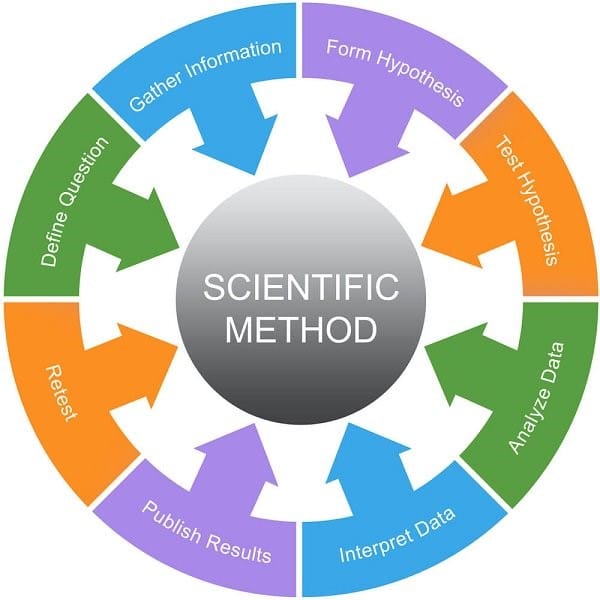
Figure: Scientific Method
7. Conclusion:
Based on the analysis, scientists draw conclusions that answer the initial question or support/reject the hypothesis. Conclusions should be based on evidence and logical reasoning. If the hypothesis is rejected, scientists revise it or form a new one and repeat the process.
II. Terms Used in the Scientific Method

Figure: Scientific Method Terms and Examples Simple Explanation
To effectively communicate and understand scientific investigations, it is essential to grasp the terminology associated with the scientific method. Here are some key terms commonly used:
1. Independent Variable:
The independent variable is the factor that is deliberately manipulated or changed by the scientist during an experiment. It is the cause or input in the cause-and-effect relationship.
2. Dependent Variable:
The dependent variable is the factor that responds to the changes in the independent variable. It is the effect or outcome being measured or observed.
3. Control Group:
In an experiment, the control group serves as a baseline for comparison. It does not receive the experimental treatment or the independent variable. The control group allows scientists to evaluate the impact of the independent variable by providing a reference point.
4. Experimental Group:
The experimental group receives the experimental treatment or the independent variable being tested. It is the group where scientists observe the effects of the independent variable on the dependent variable.
5. Variables:
Variables are factors that can be changed or measured in an experiment. Independent and dependent variables are the main types of variables, while constants are factors that remain unchanged throughout the experiment.
6. Bias:
Bias refers to the presence of any systematic error or prejudice that may affect the outcome of an experiment. Scientists strive to minimize bias by employing objective methodologies, using control groups, and applying statistical analysis.
7. Reproducibility:
Reproducibility is the ability to repeat an experiment and obtain similar results. It is a fundamental principle of scientific investigations to ensure that findings are reliable and can be validated by others.
III. Examples of the Scientific Method in Action
To illustrate how the scientific method is applied in real-world scenarios, let’s explore a few examples:
Example 1: The Growth of Plants
- Observation: A student notices that plants exposed to different amounts of sunlight appear to grow at different rates.
- Question: Does the amount of sunlight affect the growth of plants?
- Hypothesis: If plants receive more sunlight, then their growth rate will increase.
- Experiment: The student sets up multiple pots of plants, exposing them to varying amounts of sunlight while keeping other factors constant.
- Data Collection: The student measures the height of the plants every week and records the data.
- Analysis: The student analyzes the data and creates graphs to observe any patterns
Conclusion: Based on the analysis, the student concludes that plants exposed to more sunlight grew taller, supporting the hypothesis.
Example 2: Investigating the Effect of Temperature on Reaction Rate
- Observation: A chemistry student observes that a chemical reaction occurs more quickly at higher temperatures
- Question: Does temperature affect the rate of a chemical reaction?
- Hypothesis: If the temperature of a reaction is increased, then the reaction rate will also increase.
- Experiment: The student conducts multiple trials of the reaction at different temperatures while keeping other factors constant.
- Data Collection: The student measures the time taken for the reaction to occur at each temperature and records the data.
- Analysis: The student analyzes the data, creates a graph, and calculates the reaction rates at different temperatures.
Conclusion: Based on the analysis, the student concludes that the reaction rate increases with temperature, supporting the hypothesis.
Example 3: Investigating the Effect of Music on Memory
- Observation: A psychology student observes that people tend to remember information better when they study while listening to music.
- Question: Does listening to music improve memory retention?
- Hypothesis: If individuals listen to music while studying, then their memory retention will improve.
- Experiment: The student conducts a memory test with two groups: one group studies with music, while the other studies in silence.
- Data Collection: The student compares the test scores of both groups and records the data.
- Analysis: The student analyzes the data and looks for differences in test scores between the two groups.
Conclusion: Based on the analysis, the student concludes that individuals who studied music performed better on the memory test, supporting the hypothesis.
IV.FAQs:
1. Is the scientific method a linear process?
While the steps of the scientific method are often presented in a linear order, in practice, scientists may revisit and revise their hypotheses, experiments, and conclusions as they gather more data and refine their understanding.
1. Is the scientific method a linear process?
While the steps of the scientific method are often presented in a linear order, in practice, scientists may revisit and revise their hypotheses, experiments, and conclusions as they gather more data and refine their understanding.
2. Can the scientific method prove or disprove anything definitively?
The scientific method can provide evidence for or against a hypothesis, but it cannot prove anything with absolute certainty. Scientific knowledge is always subject to revision and improvement as new evidence emerges.
3. What is the role of statistics in the scientific method?
Statistics are used to analyze and interpret data in a quantitative manner, helping scientists determine whether the results of experiments are statistically significant and reliable.
4. How can the public benefit from an understanding of the scientific method?
Understanding the scientific method allows the public to critically evaluate scientific claims, make informed decisions, and participate in discussions on scientific topics.
5. Are there variations of the scientific method used in different scientific disciplines?
Yes, different scientific fields may have variations of the scientific method tailored to their specific research approaches and methodologies. However, the core principles of empirical investigation and evidence-based reasoning remain consistent.
6. What are some common misconceptions about the scientific method?
Common misconceptions include the idea that science always provides absolute truths, that it is a solitary endeavor, or that it is devoid of creativity and imagination.
Conclusion
The scientific method empowers scientists to explore the mysteries of the natural world by providing a structured approach to inquiry. By following the steps of observation, question formulation, hypothesis creation, experimentation, data collection, analysis, and conclusion drawing, scientists unravel the secrets of the universe. By understanding the key terms associated with the scientific method, students can effectively communicate and participate in scientific investigations. The examples presented in this essay showcase how the scientific method is applied across various fields, highlighting its relevance and importance in our daily lives. As an eighth-grade student, embracing the scientific method will nurture your critical thinking skills, encourage curiosity, and inspire you to become an active participant in the scientific community.